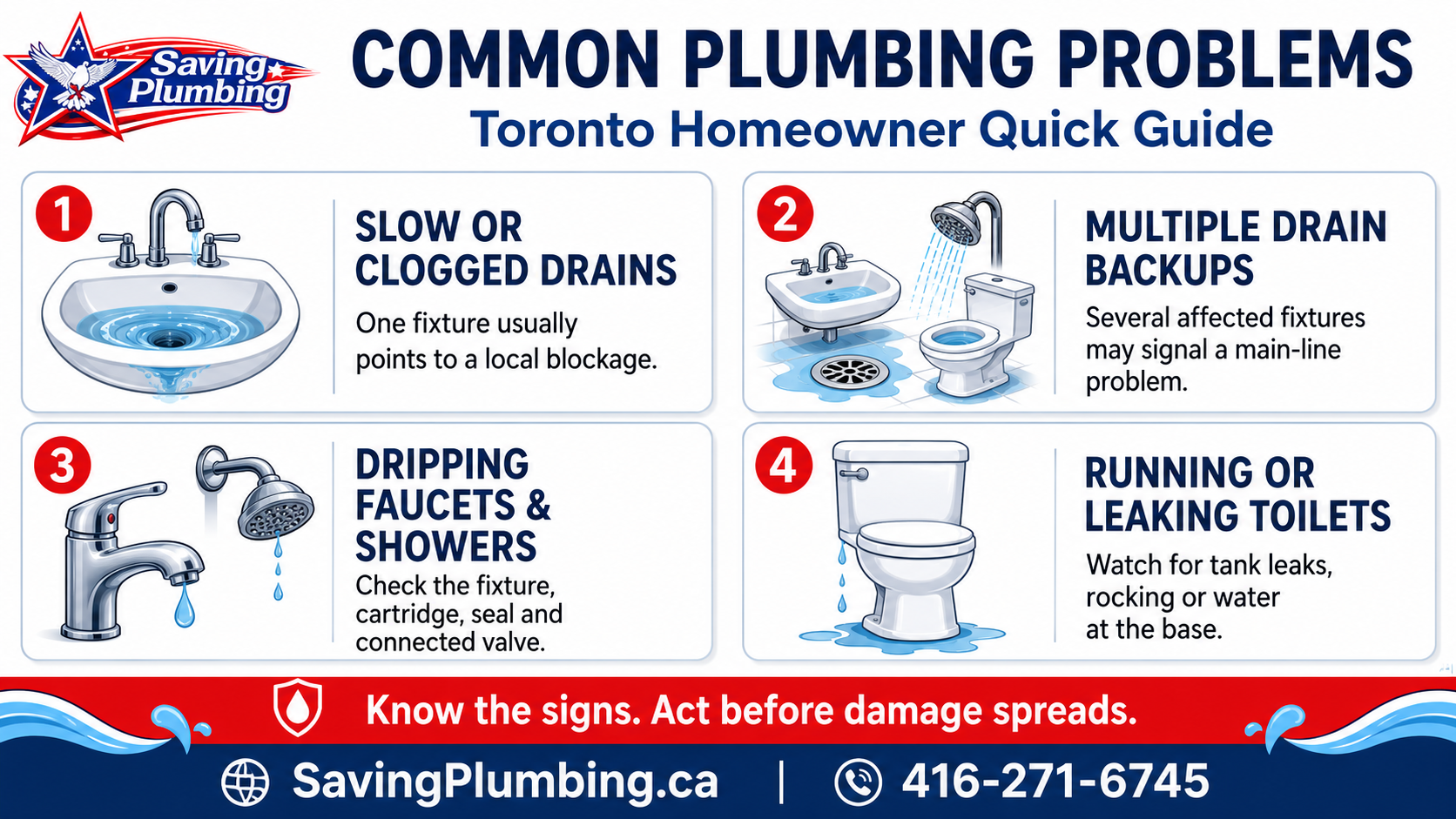
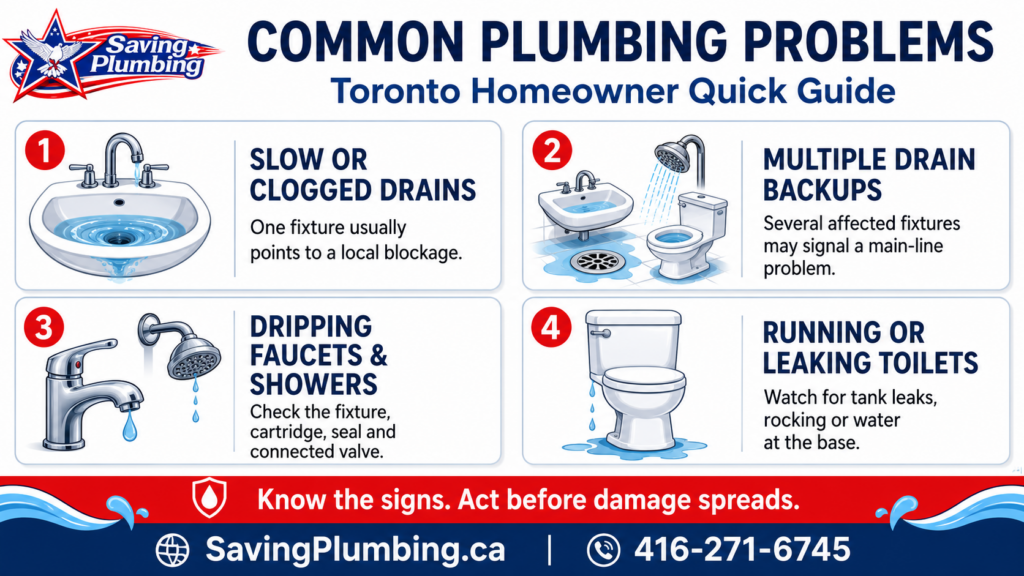
The most common plumbing issues in Toronto homes include clogged drains, leaking fixtures, running toilets, low water pressure, hidden pipe leaks, water-heater failures, frozen pipes, sewer backups and sump-pump problems. A problem affecting one fixture is usually local. See the list of the most common plumbing issues, their fixes and learn what these mean and what to do next.
12 Common Plumbing Problems in Toronto Homes
The most common plumbing problems in Toronto homes include slow drains, leaking faucets, running toilets, low water pressure, hidden pipe leaks, water-heater trouble, frozen pipes, sewer backups and sump-pump failures.
Where the symptom appears often tells you more than the symptom itself. A single slow sink usually points to its trap or nearby drain branch. Several fixtures gurgling or backing up can indicate a restriction in the main building drain or sewer lateral. Weak flow throughout the house may involve the main shutoff, pressure-reducing valve, private water service or municipal supply.
Active water, sewage or moisture near electrical equipment requires immediate attention. A stable dripping faucet or running toilet can usually be booked during regular service hours.
Toronto homeowners should also consider who controls the affected plumbing. The fault may be inside the home, within a condominium’s shared system, on the privately owned service line or on City infrastructure.
Start With the Symptom, Then Check How Far It Spreads
Before attempting a repair, test nearby fixtures and pay attention to how they react.
A plumbing problem limited to one fixture often has a local cause. A problem affecting several fixtures may sit farther along the supply or drainage system. Neighbours experiencing the same water interruption can point toward City work or a watermain problem.
| What you notice | What it may indicate | First action | Likely urgency |
|---|---|---|---|
| One sink, tub or shower drains slowly | Stopper, trap or local drain restriction | Remove visible debris and limit use | Scheduled |
| Several drains gurgle or back up | Building drain or sewer-lateral blockage | Stop using water throughout the home | Urgent |
| One faucet or shower keeps dripping | Cartridge, seal, washer or valve problem | Close the fixture shutoff if needed | Scheduled |
| A ceiling or wall stain is spreading | Concealed supply or drain leak | Stop using the connected fixture and isolate the water when possible | Same-day or emergency |
| A toilet runs between flushes | Flapper, fill valve or overflow problem | Perform a toilet dye test | Scheduled |
| Sewage enters a tub or floor drain | Main building drain or sewer connection problem | Stop all water use and avoid contact | Emergency |
| Water pressure drops throughout the house | Main valve, leak, PRV, service pipe or municipal issue | Ask neighbours and check City notices | Time-sensitive |
| The home has no hot water | Water heater, energy supply or control problem | Check for water around the heater and other safety signs | Same-day |
This early comparison can prevent the wrong fixture from being repaired or a deeper problem from being overlooked.
When water is uncontrolled, sewage is entering the property or electrical components are exposed, follow the appropriate steps for a plumbing emergency in Toronto. Stable problems can be assessed through scheduled residential plumbing service in Toronto.
Plumbing Problem #1. A Sink, Tub or Shower Drains Slowly
A single slow drain usually has a restriction close to that fixture. Hair and soap residue commonly collect beneath bathroom stoppers. Food particles, grease and cooking residue can coat kitchen drainage pipes.
Start with the visible area. Remove accessible debris from a stopper or strainer and watch how the fixture drains afterward. Keep water use limited if the basin begins filling faster than it empties.
A blockage may sit deeper in the branch when:
- The drain remains slow after visible debris is removed.
- The problem returns soon after clearing.
- Water rises in a connected fixture.
- Gurgling develops elsewhere in the room.
- A strong drain odour appears with the slow flow.
Repeated clearing can temporarily open a path through accumulated material while leaving most of the restriction behind. A damaged joint, poor drain slope or rough pipe interior can also catch debris in the same place.
Kitchen grease deserves special attention. The City advises residents to keep fats, oils and grease out of sinks and toilets because they can contribute to private drain and neighbourhood sewer backups. Grease should be allowed to harden and placed in the Green Bin according to Toronto’s drain-disposal guidance.
Small changes in disposal habits can prevent recurring drain clogs. A drain that continues slowing down needs diagnosis before it becomes completely blocked.
Plumbing Problem 2. Several Drains Gurgle, Bubble or Back Up
A wider drainage problem often reveals itself through interaction between fixtures.
A toilet may bubble when the shower drains. Water may rise in a basement floor drain when an upstairs toilet flushes. A kitchen sink can gurgle while the washing machine empties.
These reactions suggest that water and air are struggling to move through a shared drainage path. The cause may be a blocked branch, a restricted building drain, a sewer-lateral obstruction or a venting fault.
The lowest fixture often shows the first serious warning. In a Toronto house, that may be a basement floor drain, laundry sink, shower or toilet. Wastewater appearing at that level means the drainage system has lost enough capacity for sewage to reverse direction.
Stop using toilets, sinks, showers, dishwashers and washing machines when wastewater is entering the home. Additional water can increase the backup and spread contamination.
Toronto homeowners can report a blocked or backed-up basement drain through 311. According to the City’s basement-drain investigation process, Toronto Water first checks the municipal sewer. Staff may then inspect the sewer connection using a working cleanout.
When the City-owned side is clear, the blockage or damage is considered a private-side plumbing problem. The property owner is responsible for arranging the repair.
A drain camera can help distinguish accumulated waste from root intrusion, a displaced joint or damaged pipe. The number and location of affected fixtures should guide the diagnosis. Saving Plumbing’s comparison of a main sewer-line clog and a localized drain clog explains how those patterns differ.
Plumbing Problem 3. A Faucet or Shower Keeps Dripping
A steady faucet drip often comes from a worn cartridge, washer, seal or valve seat. The correct component depends on the fixture design and where the water appears.
A showerhead can release a small amount of retained water after the valve is closed. That drainage should gradually slow and stop. A drip that continues at a regular pace suggests that water is passing through the closed shower valve.
Look at the exact leak location:
- Water from the faucet spout often points toward an internal cartridge or seal.
- Moisture around the handle can come from the cartridge body or packing area.
- Water beneath the sink may involve a supply connection, shutoff valve or faucet body.
- Moisture around a shower wall plate can indicate leakage behind the trim.
- A ceiling mark below the bathroom can come from the valve, drain, fixture seal or another concealed connection.
Use the fixture shutoff when the leak is active and the valve operates normally. Stop if the valve is seized, corroded or begins leaking around its stem.
Water entering a wall or cabinet deserves prompt attention. The repair can expand beyond the fixture once moisture reaches drywall, flooring or framing.
A plumber can isolate whether the problem sits inside the fixture or within its connected piping. Saving Plumbing provides faucet repair and replacement in Toronto for leaking cartridges, damaged valves, supply connections and fixtures that no longer close properly.
Plumbing Problem #4. The Toilet Runs, Rocks, Clogs or Leaks at the Base
Toilet problems become easier to diagnose when you separate what happens inside the tank from what happens at the floor or drain.
The toilet runs between flushes
Water moving into the bowl between uses often involves the flapper, flush-valve seal, fill valve or overflow setting. The tank may refill every few minutes even though nobody has flushed.
Toronto homeowners can check for this type of leak with food colouring or a dye tablet. Place the colour in the tank without flushing and wait 10 to 15 minutes. Colour appearing in the bowl confirms that water is passing from the tank. This method is included in the City’s guidance for spotting household water leaks.
The toilet rocks at the floor
A toilet should remain stable when someone sits down or shifts position. Movement can result from loose mounting bolts, an uneven floor, damaged flange slots or deterioration around the subfloor.
Repeatedly tightening the bolts can crack the porcelain. The toilet may need to be removed so the mounting surface, flange and floor can be inspected.
Water appears around the base
Water at the floor can come from the bowl-to-flange seal, tank bolts, supply connector, shutoff valve or condensation. Timing helps narrow the source.
Water that appears during or shortly after flushing can indicate a failed wax seal or flange problem. Constant moisture near the rear of the toilet may come from the supply connection or tank.
A toilet that moves and leaks during flushing should be taken out of use. The seal depends on the fixture remaining firmly positioned over the drain opening. Saving Plumbing’s toilet flange repair guide explains how the flange, seal and finished floor work together.
The toilet clogs or bubbles repeatedly
An isolated toilet clog may sit within the trapway. Bubbling that begins when another fixture drains can involve a shared branch, venting problem or main sewer restriction.
Stop repeated flushing when the bowl is already high. If nearby drains gurgle or wastewater rises elsewhere, treat the symptom as a broader drainage problem
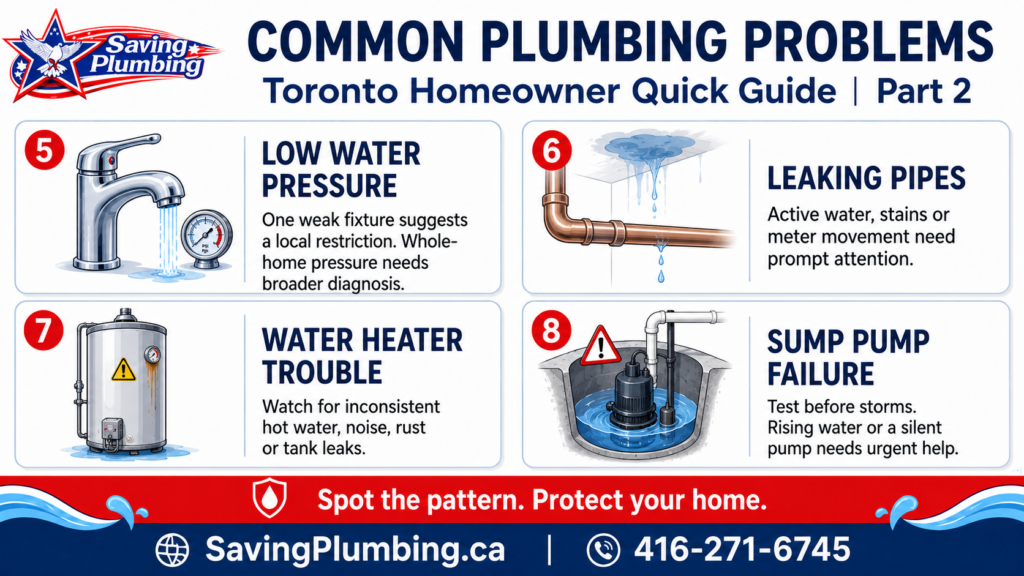
Plumbing Problem #5. Water Pressure Drops at One Fixture or Throughout the House
Low water pressure is often a flow restriction rather than a problem with Toronto’s municipal supply. The location of the weak flow provides the first useful clue.
If one faucet or shower is affected, inspect the aerator or showerhead for sediment. A blocked cartridge, worn mixing valve or partially closed fixture valve may also restrict water.
Pressure that is weak throughout the house can have a broader cause, such as:
- A partially closed main shut-off valve
- A failing pressure-reducing valve
- A concealed supply-pipe leak
- Corrosion inside older galvanized pipes
- An undersized or restricted water service
- Municipal watermain work or a neighbourhood disruption
Compare the hot and cold water. Weak hot water with normal cold flow points toward the water heater, hot-water piping or a mixing valve. Weak flow on both sides suggests a fixture restriction or wider supply problem.
A sudden whole-house change deserves prompt attention. Ask a neighbour whether their pressure has changed and check the City of Toronto’s no water or low water pressure guidance. When nearby properties have normal pressure, the problem is more likely within your private plumbing system.
Saving Plumbing’s guide to low water pressure in Toronto homes explains how to narrow the cause without adjusting regulators or dismantling pressurized components.
Plumbing Problem #6. A Pipe, Valve or Connection Is Leaking
Some plumbing leaks announce themselves with a puddle. Others remain behind drywall, beneath flooring or above a finished ceiling until the building material begins to change.
Warning signs include:
- Yellow or brown ceiling stains
- Peeling paint or softened drywall
- Damp cabinet floors
- Musty odours near plumbing fixtures
- Unexplained sounds of running water
- Reduced water pressure
- A water meter that moves while fixtures are off
- An unexpected increase in water use
The timing of the moisture can help identify the affected pipe.
A pressurized supply-pipe leak can continue whether a fixture is being used or not. A drain-pipe leak may appear only when a sink, bathtub, shower or appliance empties. Condensation can also collect on cold-water pipes during humid weather, so the presence of moisture does not always confirm a cracked pipe.
If water is actively spreading, close the main shut-off valve when it is safe to do so. Turn off the electricity to an affected area only from a dry, accessible electrical panel. Keep people away from wet light fixtures, outlets and appliances.
A small visible drip can sometimes be isolated at a fixture valve. Water emerging through a ceiling, wall or floor needs a faster response. The damaged section must be located before the repair area is opened.
Homeowners dealing with sudden water release can use the burst-pipe warning signs and immediate-action guide or request burst-pipe repair in Toronto.
Plumbing Problem #7. The Water Heater Produces Inconsistent or Discoloured Hot Water
Water-heater trouble does not always begin with a complete loss of hot water. Early symptoms may include:
- Hot water running out sooner than usual
- Water taking longer to heat
- Temperature changing during use
- Rumbling, popping or banging from the tank
- Rust-coloured hot water
- Moisture around the heater
- Weak pressure on the hot side only
- A pilot light or burner that repeatedly shuts down
Test another fixture before assuming the heater has failed. One weak shower may have a blocked showerhead or cartridge. Weak hot-water flow throughout the house could involve sediment, a valve, a mixing device or the hot-water distribution piping.
Look carefully at where any moisture originates. A leaking connection, drain valve or temperature and pressure relief assembly may be repairable. Water escaping through the body or lower seam of a storage tank often indicates internal tank failure.
Do not cap a relief-valve discharge pipe, bypass a safety control or attempt gas-component repairs. A gas smell, signs of combustion trouble or water reaching electrical components requires immediate professional attention.
Saving Plumbing provides water-heater repair in Toronto for inadequate hot water, leaks, pressure concerns and equipment breakdowns. If the tank itself is deteriorating, the guide on when to replace a water heater explains which symptoms usually support replacement rather than another repair.
Plumbing Problem #8. The Sump Pump Does Not Start, Stop or Discharge Water Properly
A sump pump may sit quietly for weeks and then become essential during heavy rain or rapid snowmelt. Waiting for water to reach the basement floor is a poor way to discover that the pump has failed.
Common warning signs include:
- The pump does not start as the pit fills
- The motor hums without moving water
- The pump starts and stops every few seconds
- The unit runs continuously
- The float switch is obstructed
- The alarm activates
- Water returns to the pit after each cycle
- The discharge line is blocked, disconnected or frozen
- The backup battery shows a fault or low-charge warning
Before touching the system, keep cords and connections away from standing water. A homeowner can visually check whether the plug has come loose, whether a breaker or GFCI has tripped, and whether an obvious object is preventing the float from moving. Disconnect power before reaching into the pit.
Repeated cycling may come from a float problem, faulty check valve, undersized pit or water returning through the discharge line. Continuous operation can indicate high groundwater, a stuck switch or a pump that cannot keep up. A humming motor may be jammed or mechanically damaged.
If the water level continues to rise, protect valuables and arrange urgent service. Do not rely on a primary pump alone during a power outage. A properly sized battery-backup system provides a second pumping source when electricity or the main pump fails.
Toronto homeowners planning flood-protection work should review the current Basement Flooding Protection Subsidy Program. The program currently lists support for eligible plumbing assessments, sump pumps, alarms, battery backups, backwater valves and certain foundation-drain work. Eligibility and maximum amounts should be confirmed before work begins.
Saving Plumbing offers sump-pump repair and installation in Toronto for failed pumps, switch problems, blocked discharge lines and backup-system upgrades.
Plumbing Issue #9. A Water Line Freezes During Toronto’s Winter
A frozen water line may first appear as weak flow or no water at a single faucet. Other warning signs include frost on exposed piping, a bulge in the pipe, unusual noises and a sudden pressure change during cold weather.
Pipes are more vulnerable in:
- Exterior walls
- Unheated garages
- Crawl spaces
- Attics
- Poorly insulated basements
- Cabinets against outside walls
- Areas exposed to cold drafts
A pipe can crack while frozen and remain relatively dry until the ice begins to thaw. Watch the affected area closely as water flow returns. Dampness, staining or a hissing sound can indicate that the pipe has split.
If the frozen section cannot be located, the pipe appears damaged or water begins escaping, close the main shut-off valve and arrange professional help. Saving Plumbing provides frozen-pipe repair in Toronto for restricted, cracked and burst water lines.
Prevention should begin before the next cold spell. Disconnect outdoor hoses, drain exterior water lines, seal cold-air leaks and insulate pipes near exterior walls. Areas that have frozen once deserve further investigation because the same temperature and insulation conditions can cause another failure.
Plumbing Issue #10. A Persistent Sewer Smell Comes From a Drain or Bathroom
A plumbing trap holds a small amount of water that blocks sewer gases from entering the home. When an infrequently used sink, shower or floor drain dries out, the water seal disappears and an odour can travel through the opening.
Run water into a seldom-used fixture and wait to see whether the smell clears. A floor drain may need enough water to refill its trap. Odour that returns quickly can point to a cracked trap, leaking connection, venting problem or another drainage fault.
Location and timing provide useful clues:
- Odour near an unused floor drain may come from a dry trap.
- A smell concentrated around a toilet can involve a failed seal or damaged flange.
- Odour accompanied by gurgling may involve restricted airflow or a blocked vent.
- Several smelly, slow or backing-up drains can indicate a main sewer-line problem.
- A smell outside near a sewer route may accompany damaged piping or root intrusion.
Avoid masking a persistent sewer smell with air freshener or repeated chemical treatments. The source may sit below a fixture, inside a wall, at a vent connection or underground.
When sewer odour appears with recurring clogs, bubbling toilets or basement drainage problems, a video camera inspection can reveal root intrusion, pipe damage, heavy buildup, misaligned joints or a partial obstruction.
A rotten-egg smell near a furnace, water heater, gas appliance or gas line requires a different response. Leave the property and follow Enbridge Gas emergency guidance. Call 911 or Enbridge Gas at 1-866-763-5427 from a safe location.
Plumbing Issue #11. Pipes Bang, Rattle, Whistle or Gurgle
Plumbing noises help identify where pressure, movement or drainage has changed. The sound, timing and affected fixture matter more than volume alone.
| Sound or pattern | Possible explanation | What to observe |
|---|---|---|
| A bang when a valve closes | Water hammer, high flow velocity or loose piping | Note whether it follows a washing machine, dishwasher, toilet or fast-closing faucet |
| Rattling inside a wall | Poorly supported pipe or contact with framing | Check whether the noise begins only while water is flowing |
| Whistling at one fixture | Restricted valve, cartridge, supply stop or fill valve | Compare the fixture’s flow with nearby fixtures |
| Ticking after hot water use | Pipe expansion against framing or supports | Notice whether the sound fades as the pipe cools |
| Gurgling from a drain or toilet | Restricted drainage, displaced air or vent trouble | Check whether another fixture triggers the sound |
| Repeated knocking near a water heater | Valve activity, pressure movement or equipment trouble | Note whether hot-water demand causes the noise |
A water-hammer arrestor may help when a fast-closing appliance valve creates the shock, but it will not correct every banging pipe. Excessive pressure, failed components and unsupported piping require different repairs.
Drain gurgling also belongs to a separate diagnostic path. When several fixtures react to each other, the main drain, branch line or vent system may be restricted. Saving Plumbing’s explanation of a bubbling or gurgling toilet shows how fixture patterns can separate a toilet clog from a broader drainage problem.
Arrange an assessment when the sound is new, forceful, repeated or accompanied by low pressure, leakage, pipe movement or drainage changes.
Plumbing Issue #12. Older Pipes Cause Recurring Leaks, Restrictions or Water Concerns
Toronto homes may contain plumbing materials installed during different renovation periods. One property can have newer copper or PEX supply lines alongside older galvanized steel, cast iron, clay or lead service components.
Each material presents a different concern.
Galvanized steel can corrode internally. The opening becomes narrower, which may reduce flow and release rust-coloured particles. Cast-iron and clay drains can develop scale, displaced joints, cracks or root entry. Older valves and mixed-material connections may also become unreliable.
Lead service pipes require special attention because they concern drinking-water quality. Toronto states that lead service pipes are most likely in homes built before the mid-1950s. A licensed plumber can inspect the service entering near the water meter, while water testing determines whether lead is present in the water.
Useful signs of an aging plumbing system include:
- Repeated leaks in different areas
- Ongoing pressure loss
- Rust-coloured water
- Visible corrosion or mineral deposits
- Frequent drain blockages
- Several past sectional repairs
- Brittle or deteriorated shut-off valves
- Known lead or galvanized service piping
A repiping decision should consider the material, exposed condition, repair history, water quality, pressure and number of failing sections. One damaged connection may need a targeted repair. Failures appearing across several branches can make a planned replacement more practical.
The guide to replacing plumbing pipes in a Toronto home explains how to compare a localized repair with sectional or whole-home repiping.
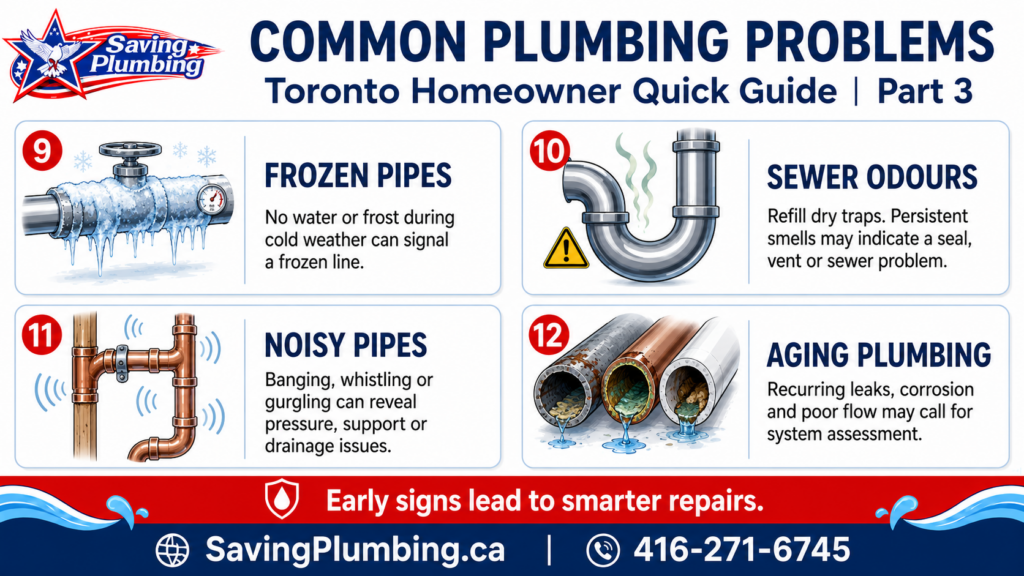
The broad “common plumbing problems in Toronto” intent is distinct from Saving Plumbing’s narrower drain, pipe, water-heater and sump-pump articles. Those supporting pages deepen individual problems without competing with the broader diagnostic purpose of this article.
What Should You Do When a Plumbing Problem Appears?
Start by limiting water use around the affected fixture. A slow sink may remain usable for brief testing. A leaking toilet, overflowing drain or damaged supply pipe should be taken out of service.
Use this sequence:
- Identify the affected fixtures. Determine whether the problem involves one fixture, one room or the entire house.
- Stop the water when necessary. Close the fixture valve or main shut-off valve if clean water is escaping.
- Keep clear of electrical hazards. Stay away from wet outlets, fixtures and appliances. Operate the electrical panel only when the route and panel are dry.
- Check nearby properties. Whole-house pressure loss or no water may involve a municipal disruption.
- Record what happened. Note when the problem began, what triggers it and whether any recent plumbing work occurred.
- Avoid repeated testing. Flushing a blocked toilet or running water through a leaking drain can spread damage.
- Arrange the appropriate response. The severity, water source and ability to isolate the problem determine how quickly help is needed.
Photos of staining, leaking connections or unusual meter movement can help explain the issue. A short video may also capture intermittent sounds or changes that stop before the plumber arrives.
Is It a Plumbing Emergency or a Scheduled Repair?
The amount of visible water does not always reflect the seriousness of the problem. A slow concealed leak can damage flooring and framing, while a dripping faucet may remain suitable for a scheduled appointment.
| Situation | Recommended response |
|---|---|
| Burst pipe or uncontrolled supply leak | Close the main valve when safe and request emergency plumbing help |
| Sewage entering the home | Stop using plumbing fixtures and request urgent service |
| Water near electrical equipment | Keep away from the area and arrange emergency assistance |
| Sump pit filling while the pump remains off | Protect valuables and request urgent sump-pump service |
| Frozen pipe with visible cracking or leaking | Close the water and arrange prompt diagnosis |
| Water-heater tank actively leaking | Shut off the water and energy supply only when you can do so safely |
| Repeated main-drain backups | Limit water use and arrange same-day investigation |
| Slow single drain or minor fixture drip | Schedule service before the problem becomes more disruptive |
| Pipe noise without leakage or pressure loss | Record when it occurs and book a regular assessment |
| Planned replacement of older plumbing | Arrange an inspection and written scope of work |
Saving Plumbing’s guide to what counts as a plumbing emergency provides a more detailed response framework for leaks, sewer backups, frozen pipes and loss of essential plumbing service.
Should You Call a Plumber, Your Building Manager or the City?
The location and number of affected properties can help determine who should investigate.
Contact a plumber when:
- One fixture or private plumbing branch is affected
- Water is leaking inside the property
- A private drain repeatedly blocks
- The water heater, sump pump or plumbing fixture has failed
- Older pipes show corrosion or restricted flow
- The main shut-off valve will not operate
- Neighbours have normal water service
Contact the landlord or building manager when:
- You rent the property
- Several units share the same problem
- A condo riser, booster pump or shared drain may be involved
- Building maintenance recently interrupted water service
- Access to a mechanical room or main valve is required
Contact Toronto 311 when:
- Several nearby properties have lost water or pressure
- A watermain break or municipal disruption is suspected
- A basement drain or sewer service has backed up
- The City-owned water meter or service requires attention
- The private shut-off valve cannot stop an active leak and a curb-side shutoff is required
report blocked sewer service lines and basement flooding through 311. Reporting the incident allows Toronto Water to investigate the municipal side while a plumber assesses the private drainage system.
A Practical Plumbing Prevention Routine
Plumbing maintenance becomes easier when checks are tied to fixtures and seasonal changes.
Around the house
- Learn where the main shut-off valve is located.
- Keep the valve accessible.
- Look beneath sinks for dampness or swollen cabinet material.
- Check around toilets for movement, staining or water at the base.
- Watch ceilings below bathrooms and laundry areas.
- Investigate changes in pressure, sound or water colour.
- Replace damaged appliance hoses and leaking connections.
For drains and toilets
- Use strainers in kitchen sinks, tubs and showers.
- Keep grease, wipes, hygiene products and food scraps out of drains.
- Address clogs that return after plunging.
- Refill traps in rarely used sinks, showers and floor drains.
- Avoid repeated chemical drain treatments when the cause is unknown.
Before winter
- Disconnect outdoor hoses.
- Drain and close exterior water lines where applicable.
- Seal cold drafts around plumbing penetrations.
- Insulate vulnerable pipes in unheated areas.
- Keep plumbing spaces warm during extended absences.
Before heavy rain
- Test the sump pump.
- Check that the float can move freely.
- Inspect the discharge route.
- Review the condition of the backup battery.
- Keep basement floor drains accessible.
- Confirm that flood alarms are working.
A recurring symptom deserves more attention than an isolated inconvenience. Repeated blockages, leaks appearing in different rooms and continuing pressure loss can reveal a larger system problem.
Need a Plumber in Toronto or the GTA?
Saving Plumbing diagnoses and repairs household plumbing problems across Toronto and supported GTA communities. Services include drain cleaning, camera inspections, fixture repair, leak detection, pipe repair, water-heater service, sump-pump work and emergency plumbing.
Call 416-271-6745 when water is actively spreading, sewage is backing up or an essential plumbing system has failed. For a non-urgent concern, request a plumbing assessment and describe which fixtures are affected, when the symptom began and what you have already checked.
Frequently Asked Questions
What are the most common plumbing problems in Toronto homes?
Frequently encountered problems include clogged drains, dripping fixtures, running toilets, low water pressure, pipe leaks, water-heater trouble, sump-pump failure and frozen pipes. Older properties may also experience corroded supply lines, damaged drains and outdated service piping.
How can I tell whether a plumbing problem affects one fixture or the whole house?
Test comparable fixtures in different rooms. One weak faucet points toward its aerator, cartridge, valve or local branch. Several affected fixtures may indicate a main supply, pressure, drainage or sewer-line problem.
Can I fix a plumbing problem myself?
Homeowners can safely complete simple checks such as cleaning a removable aerator, refilling a dry trap, checking beneath a sink and confirming that an accessible shut-off valve is open. Work involving gas, electricity, concealed leaks, sewer backups, pressure regulators or damaged pipes requires qualified help.
How do I know whether a leak is hidden behind a wall?
Possible signs include stains, softened drywall, peeling paint, musty odours, unexplained running-water sounds and meter movement while fixtures are off. These clues support further investigation but do not identify the exact location by themselves.
Does an older Toronto house need complete repiping?
The decision depends on pipe material, condition, water quality, pressure, repair history and the number of failing sections. A localized defect may need one repair. Recurring leaks or restrictions across several branches can support sectional or whole-home replacement.
Who is responsible for a sewer backup in Toronto?
Responsibility depends on where the blockage or damage is located. Toronto Water investigates the municipal system, while the property owner is generally responsible for private plumbing and the private sewer connection. Report the backup to 311 and arrange a plumbing assessment when the source is uncertain.
When should I call an emergency plumber?
Request emergency service for uncontrolled leaks, burst pipes, sewage entering the home, water near electrical equipment, a rapidly filling sump pit or a plumbing failure that cannot be safely isolated.
