
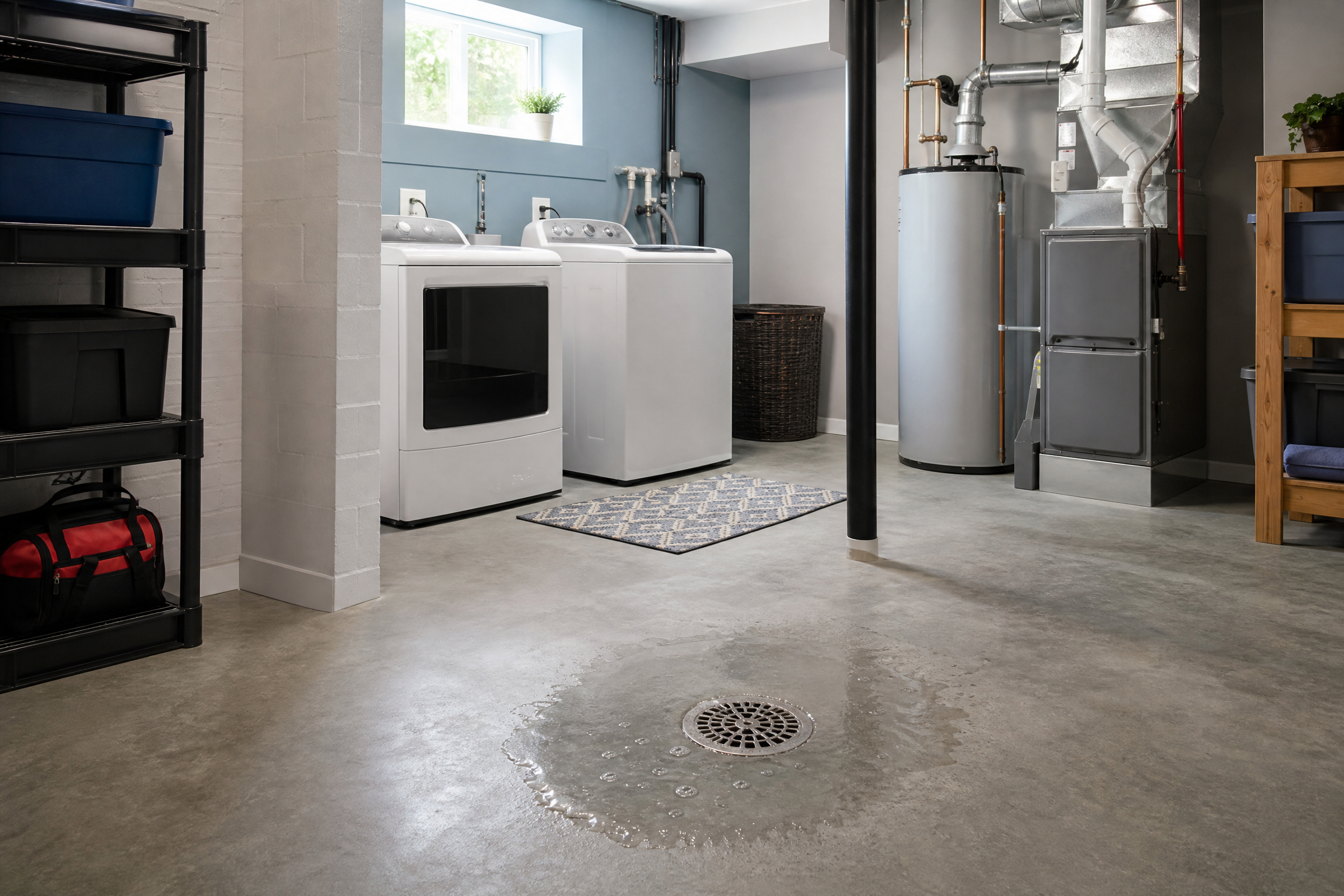
Scarborough Basement Floor Drain Backing Up: After Rain, Shower, Kitchen
A basement floor drain can back up when wastewater reaches a restriction and starts moving toward one of the lowest openings in the home’s drainage system.
The blockage may be close to the floor drain. It may also be farther downstream in a shared building drain or the sewer service line leading toward the municipal sewer.
The timing of the backup gives you one of the most useful clues.
A floor drain that rises when someone showers upstairs suggests a shared drainage restriction. A backup during laundry points toward the same type of downstream problem. Water or sewage appearing during heavy rain adds municipal sewer conditions and flood protection to the investigation.
For Scarborough homeowners, a suspected sewer-service backup can also involve Toronto Water because responsibility for the sewer connection is divided between the property owner and the City at the property line
What Does the Timing of a Basement Floor Drain Backup Tell You?
Watch what is happening elsewhere in the house when the basement drain reacts.
| What happens | Where to investigate first |
|---|---|
| Only the floor drain drains slowly | Floor-drain trap or nearby branch |
| Floor drain backs up after shower | Shared building drain or sewer service |
| Floor drain rises when toilet flushes | Shared drain or sewer service line |
| Floor drain backs up when kitchen sink drains | Shared drain, grease buildup or deeper restriction |
| Floor drain backs up when doing laundry | Shared building drain |
| Several fixtures become slow together | Building drain or sewer service |
| Backup happens when it rains | Sewer surcharge, restriction or flood protection |
| Poop or black water comes up | Active sewage backup |
| Clear water appears around foundation walls | Groundwater or foundation drainage |
The location of the water tells only part of the story.
A basement floor drain can become the place where a deeper drainage problem becomes visible because it sits lower than many fixtures elsewhere in the house.
Is it sewage or groundwater?
The appearance and timing of the water can provide clues, but they cannot replace a professional assessment. Sewage backup is more likely when the water is dark, cloudy, or foul-smelling; contains solids; rises after a toilet is flushed or a sink, shower, washing machine, or dishwasher is used; or appears alongside gurgling fixtures elsewhere in the home.
Groundwater or rain-related intrusion is more likely when the water is relatively clear and appears during or shortly after heavy rain or rapid snowmelt. However, a storm can also overload a sewer system and push contaminated water into a basement. Treat unknown standing water cautiously, particularly if it has contacted electrical equipment, stored belongings, or porous flooring.
“Every home is at risk of basement flooding, even if it has not happened before.” — City of Toronto
What Commonly Blocks a Sewer Line in Scarborough?
Several materials and pipe conditions can restrict a sewer service.
Fats, Oils and Cooking Grease
Toronto identifies cooking grease as a common sewer-blockage cause.
Grease enters the drain warm, then cools and sticks to pipe walls. Additional material can collect on that buildup until the usable opening becomes much smaller.
Wipes and Hygiene Products
Toronto specifically warns that wipes, including products labelled flushable, do not break down like toilet paper and can contribute to blockages.
Tree Roots
Roots can grow through openings in sewer pipes.
Toronto lists root intrusion as one cause of sewer-service blockages.
Recurring root problems can justify camera inspection because the pipe defect that allowed the roots inside may still be present.
Cracked or Deteriorated Pipe
Toronto notes that sewer pipes can crack and deteriorate over time and specifically references older cast-iron and clay piping.
A damaged area can collect debris, admit roots or reduce normal flow.
Why Does a Basement Floor Drain Back Up?
Several conditions can create enough restriction or reverse flow for wastewater to reach the basement.
Toronto identifies fats and cooking grease, wipes and hygiene products, tree roots, broken sewer pipes and heavy rainfall among common causes of sewer backups. The City also notes that older sewer piping may include cast iron or clay that can crack or deteriorate with age.
A recurring backup therefore deserves more investigation than simply reopening the pipe every time it blocks.
The most useful diagnosis determines:
- where the restriction is located
- what is causing it
- whether the pipe itself is damaged
- whether City infrastructure is involved
- whether flood-protection equipment could reduce future risk
Why Does My Basement Floor Drain Back Up After a Shower?
If the basement floor drain rises or gurgles while someone is showering, the shower is probably sending water into a shared drain that has become restricted farther downstream.
A shower releases a steady stream of wastewater for several minutes.
A partially restricted drain may still handle small amounts of water from a hand sink. Sustained shower flow can fill the pipe faster than the restriction allows it to empty.
The basement floor drain may first begin to gurgle. Water can then rise through the grate if more wastewater enters the system.
Check whether other lower-level fixtures are also slow.
A basement toilet, laundry sink or floor drain reacting during the same shower makes a shared drainage problem more likely.
Once wastewater starts appearing through the basement drain, stop the shower and limit other water use until the blockage is investigated.
Why Does My Basement Floor Drain Back Up When I Flush the Toilet?
A floor drain that reacts to toilet flushing suggests that both fixtures eventually connect to the same drainage path.
Each flush sends a relatively large volume of water into the system.
When a blockage exists farther downstream, the new wastewater can push air and water backward toward lower openings. You may hear bubbling before water becomes visible.
Repeated flushing can send additional wastewater into the basement.
Check whether other fixtures are producing the same reaction. Several fixtures influencing the floor drain gives a plumber useful evidence about the location of the restriction.
Why Does My Basement Floor Drain Back Up When the Kitchen Sink Drains?
A kitchen sink and basement drain may eventually connect to the same building drain.
A full kitchen sink released at once sends a larger volume of wastewater through that system. If a restriction exists farther downstream, the basement floor drain may bubble or begin to rise.
Kitchen drainage introduces another possible contributor: grease.
The City of Toronto warns that fats, oils and cooking grease cool, harden and stick to the inside of plumbing and sewer pipes. Continued buildup can eventually block the pipe and contribute to sewer backups.
If the kitchen sink has also become slow, the plumber may need to inspect both the kitchen branch and the shared drainage farther downstream.
A normal-draining kitchen sink that consistently causes the basement drain to react can point toward a restriction beyond the kitchen branch.
Why Does My Basement Floor Drain Back Up When Doing Laundry?
Washing machines discharge a substantial amount of water within a relatively short period.
That sudden flow can expose a drainage restriction that remains less noticeable during ordinary faucet use.
You may first notice bubbling around the basement floor drain while the washing machine empties. With a more significant restriction, water can rise through the drain.
Check whether a nearby laundry sink or basement toilet also reacts.
A floor drain that backs up every time the washing machine enters its drain cycle deserves an inspection of the shared building drain.
Avoid repeatedly running another cycle to test it once wastewater has already appeared.
Why Does My Basement Floor Drain Back Up When It Rains?
Heavy rain introduces a different set of conditions.
Toronto states that municipal sewers can become full during periods of heavy rainfall, which can contribute to water entering homes.
A private sewer restriction can also become more noticeable during a storm.
A line that handles ordinary household flow may perform differently when municipal sewer conditions change during heavy rain.
Pay attention to whether the problem happens:
- during every significant rainfall
- only during unusually severe storms
- after prolonged rainfall
- together with slow toilets or drains
- at neighbouring properties during the same event
Repeated rain-related backups deserve a broader flood-protection assessment.
Toronto specifically encourages homeowners experiencing basement flooding or a blocked sewer service line to report the incident to 311 so City infrastructure can be investigated.
Why Does My Basement Floor Drain Back Up After Heavy Rain?
A backup after heavy rain can appear even after the rainfall has slowed or stopped.
Water may still be moving through municipal and private drainage systems after the storm.
A restriction in the private sewer service can reduce the amount of flow the line can handle. High municipal sewer levels can add another factor.
The timing should be documented.
Record when the rain began, when the floor drain first reacted and whether any toilets or other fixtures became slow.
That information can help Toronto Water and the plumber understand whether the event appears connected to storm conditions.
A repeat pattern across several storms provides particularly useful evidence.
Why Is Poop Coming Up Through My Basement Floor Drain?
Fecal material or toilet paper appearing through a basement floor drain means sewage is travelling backward through the drainage system.
Stop flushing toilets and reduce other water use immediately.
Showers, washing machines, dishwashers and sinks can all add more wastewater behind an existing blockage.
Keep people and pets away from the affected area and avoid direct contact with sewage.
For a Scarborough property, report the sewer backup to 311. Toronto says blocked sewer-service lines and basement flooding should be reported so staff can investigate whether City infrastructure is involved.
A licensed plumber may also need to investigate the homeowner-owned drainage system.
The location of the blockage determines who is responsible for the repair.
Why Is Black Water Coming Up Through My Basement Drain?
Dark or black wastewater coming through a basement floor drain should be treated as a sewer-backup symptom.
The colour can come from wastewater, organic material and debris moving through the drainage system.
Look for other evidence of a sewer problem, including:
- sewage odour
- toilet paper or waste
- bubbling toilets
- multiple slow drains
- a backup that worsens when plumbing fixtures are used
Stop unnecessary water use while the source is being investigated.
The appearance of dark wastewater through a basement drain gives more urgency to the situation than an isolated floor drain that is merely slow to empty.
What to do immediately when a basement drain backs up
1. Stop using water in the house
Do not flush toilets, run taps, use the shower, operate the washing machine, or start the dishwasher. Water discharged upstairs may travel to the same blocked line and force more water through the basement floor drain.
2. Keep people and pets away
Do not walk through standing water barefoot. If you must approach the area, wear waterproof boots and gloves, and keep children and pets out. If water is near outlets, furnaces, electrical panels, or appliances, do not enter the area to shut off power; contact a qualified professional or emergency service if there is an electrical risk.
3. Check the pattern without touching the water
Note whether other fixtures are slow, whether toilets gurgle, whether the water rises when a fixture is used, and whether the event followed rainfall or snowmelt. This information helps a plumber distinguish a local blockage from a main sewer-line problem.
4. Avoid chemical drain cleaner
Liquid drain chemicals are a poor choice for a backed-up basement drain. They may sit in the pipe, fail to reach a deeper obstruction, damage older plumbing, and create a splash hazard for the homeowner or technician. Do not mix products.
5. Call for professional help when the warning signs are present
Contact Saving Plumbing promptly if sewage is present, the water is still rising, multiple drains are affected, the backup returns, or the basement has a strong sewer odour. A recurring backup should be investigated even if the water eventually drains away.
Who Pays for a Basement Sewer Backup in Scarborough?
Responsibility generally depends on where the blockage or damaged pipe is located.
Toronto divides ownership at the property line.
| Location | General responsibility |
|---|---|
| Municipal sewer under the street | City of Toronto |
| Sewer service from municipal sewer to property line | City of Toronto |
| Sewer service from property line toward the home | Property owner |
| Building drains inside the property | Property owner |
| Local floor-drain blockage | Property owner |
The City owns the section running from the sewer main to the property line. The homeowner owns the sewer service from the property line into the home.
If CCTV shows the City-side section is clear, the problem is considered to be on the private side and the property owner is advised to arrange a licensed plumber in Scarborough ON..
This is why locating the obstruction matters before major sewer repair work begins.

Does a Basement Floor Drain Backup Need a Sewer Camera?
A sewer camera is especially useful when the blockage keeps returning or the condition of the pipe is uncertain.
The camera can help reveal accessible portions of:
- root intrusion
- cracked pipe
- separated joints
- deterioration
- remaining obstructions
- recurring trouble spots
Toronto Water also uses CCTV during its own investigation of accessible City-side sewer-service connections.
A camera may have limited visibility when the line is completely blocked or filled with wastewater.
The drain sometimes needs to be opened first so the camera can travel far enough to inspect the problem area.
When Is Drain Snaking Enough?
Drain snaking may be enough when the cause is a removable obstruction and the pipe remains in serviceable condition.
A first-time blockage caused by accumulated material may clear and remain open after proper cleaning.
The situation deserves a deeper investigation when the same line repeatedly blocks.
If roots, a damaged joint or deteriorated pipe are involved, clearing the immediate obstruction may restore flow without addressing the physical condition that caused the problem.
A recurring backup should eventually answer a more specific question:
Why does this part of the sewer keep blocking?
That is where camera inspection and pipe-location information can become more valuable.
Will a Sump Pump Stop Water Coming Up Through a Basement Floor Drain?
A sump pump handles water collected in a sump pit, typically from foundation drainage.
Wastewater rising through a basement floor drain belongs to the drainage and sewer system.
Installing a sump pump does not directly clear a blocked sanitary drain or prevent sewage from travelling backward through a sewer connection.
A home may benefit from a sump system for groundwater protection while also needing sewer-backup protection.
Would a Backwater Valve Help With a Basement Floor Drain Backup?
A backwater valve is designed to close when flow reverses through the sewer connection toward the house.
That makes it relevant when sewer backflow is part of the basement-flooding risk.
The correct installation depends on the home’s drainage configuration and sewer connections.
Toronto requires a building permit for backwater-valve installation. The City’s current permit guidance also specifies requirements for the type and placement of the valve.
If the home already has a backwater valve and still experiences sewer backups, the valve itself and the surrounding drainage system should be inspected.
Is There a Toronto Subsidy for Preventing Another Basement Backup?
Yes.
Scarborough properties are within the City of Toronto and eligible homeowners can apply through Toronto’s Basement Flooding Protection Subsidy Program.
As of May 1, 2026, the program provides up to $6,650 per eligible property for qualifying work completed on or after November 12, 2025.
Current maximum subsidy amounts include:
| Eligible work | Maximum subsidy |
|---|---|
| Home plumbing assessment | $500 |
| First backwater valve | $1,600 |
| Second eligible backwater valve | $1,600 |
| Sump pump | $2,250 |
| Sump pump battery backup | $300 |
| Foundation-drain severance and capping | $400 |
Toronto generally provides up to 80% of eligible invoiced costs within the program limits.
The home plumbing assessment is particularly relevant after a basement backup.
Toronto offers up to $500 toward an eligible assessment by a certified and licensed toronto plumber to identify plumbing issues that could contribute to basement flooding. The homeowner does not have to complete every recommendation to receive the assessment subsidy.
A backwater-valve installation requires a permit and inspection when applying through the program.
Can You Prevent Another Basement Floor Drain Backup?
The useful prevention measure depends on what caused the first backup.
Keep fats, oils and cooking grease out of kitchen drains. Toronto recommends letting grease cool and disposing of it through the appropriate waste stream rather than washing it into the plumbing system. Sink strainers can also keep food solids out of the drain.
Avoid flushing wipes and hygiene products.
A sewer line with recurring roots or structural damage deserves inspection after it has been cleared.
Homes with storm-related sewer-backup risk may need an assessment for a backwater valve.
Properties with groundwater concerns may need sump-pump or foundation-drain work.
A repeat backup should provide more information about the drainage system than the previous one.
Basement Floor Drain Backup FAQs
Why Is My Basement Floor Drain Gurgling but No Water Is Coming Up?
Gurgling can happen before a visible backup develops.
Air may be moving through the trap because drainage farther downstream is restricted.
Check whether toilets, showers, laundry or kitchen drainage cause the sound to become stronger.
A new recurring gurgle deserves attention before wastewater begins rising through the drain.
Can I Pour Drain Cleaner Into a Basement Floor Drain?
Chemical drain cleaner does not identify whether the problem is local to the floor drain or farther down the building sewer.
A sewer-service blockage, root intrusion or damaged pipe requires a different approach.
If drain chemicals have already been used, tell the plumber before the line is opened or serviced.
Should I Call a Plumber First?
For a suspected sewer-service backup or basement flooding, Toronto asks residents to report the incident to 311 so Toronto Water can investigate whether City infrastructure is involved.
A plumber can investigate and repair the homeowner-owned portion of the drainage system.
When sewage is actively backing up, both processes may be relevant.
Why Does My Basement Floor Drain Keep Backing Up After It Was Snaked?
A recurring blockage can mean the obstruction was temporarily opened while the underlying cause remains.
Roots, deteriorated piping, a damaged joint or recurring buildup can cause the same location to block again.
Repeated backups are a good reason to consider camera inspection after the line has been opened.
Need a plumber for a backed-up basement drain?
A basement floor drain backup can escalate from a small blockage into water damage, contamination, or a repeat sewer problem. Saving Plumbing provides 24/7 plumbing support across Toronto and the GTA, including drain cleaning and snaking, drain repair, sewer camera inspection, sump-pump service, and emergency plumbing.
Call (416) 271-6745 or request a free plumbing quote from Saving Plumbing and describe what you are seeing: where the water is coming from, whether it smells like sewage, which fixtures are affected, and whether the problem followed rain or snowmelt. The more detail you provide, the faster the right next step can be identified.
