

For most residential plumbing services in Toronto, homeowners can expect to pay about $150 to $500 for a standard service call or repair, while complex plumbing jobs can cost $1,000 or more. Current Toronto plumbing rates generally range between $95 to $190 per hour, depending on the contractor and work involved. Service-call or initial inspection charges are commonly separate and may add about $150 to $200.
The cost of a plumber in Toronto depends on the type of plumbing service, repair complexity, labour time, parts and materials, pipe accessibility, specialized equipment, and whether the work is scheduled or requires emergency service. A simple faucet or toilet repair costs much less than locating a concealed pipe leak, clearing a main sewer line, replacing a water heater, or repairing underground drainage.
At Saving Plumbing, we recommend looking at the total cost of the plumbing job rather than comparing hourly rates alone. A plumber may charge by the hour, use flat-rate pricing, or combine a service-call or diagnostic fee with the cost of labour and materials. Knowing what the quoted price includes makes it easier to compare Toronto plumbers and avoid surprises when the work is complete.
NOTE – A plumbing symptom identifies where a problem appears. Diagnosis identifies its cause. The cause determines the repair scope, and the repair scope determines the final plumbing cost.
Average Plumbing Costs in Toronto for 2026
For most Toronto homeowners, the useful starting point is the service structure, rather than a single city-wide average. A short fixture repair, an investigation into a hidden leak and a blocked building sewer can all involve very different amounts of time and equipment.
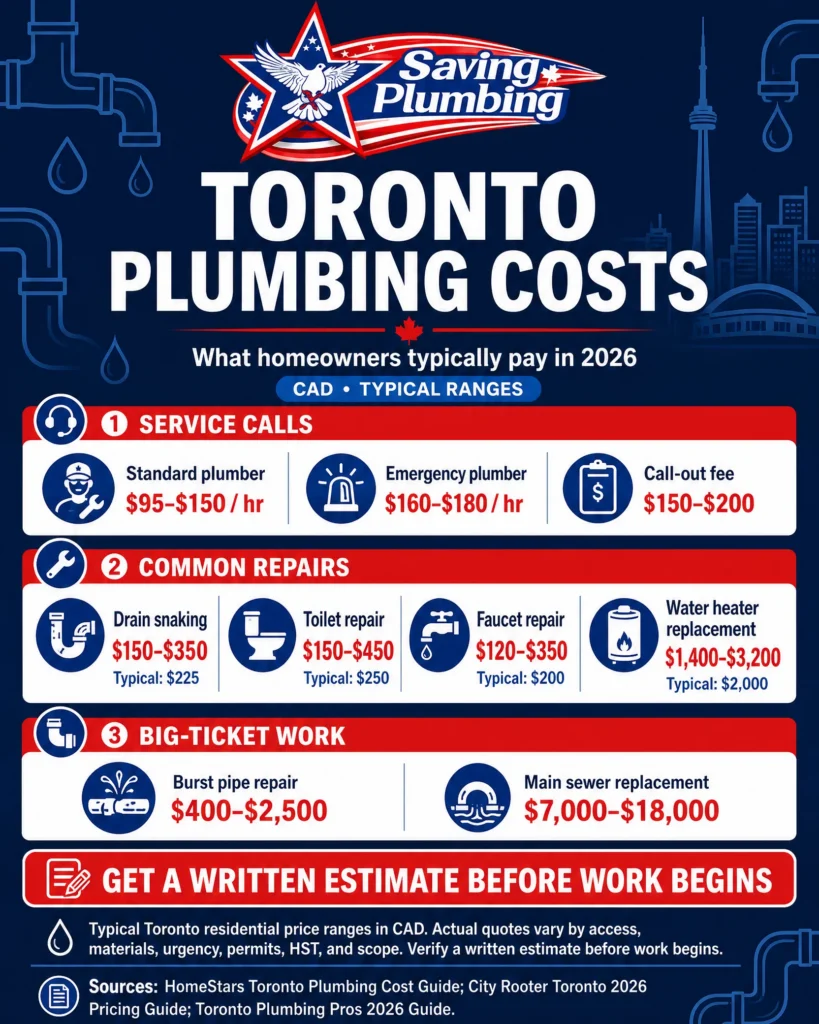
Current 2026 Toronto pricing data gives homeowners these practical benchmarks:
| Toronto plumbing cost | Typical range | What the charge usually represents |
|---|---|---|
| Regular daytime plumber labour | $95 to $150 per hour | Standard plumbing work during regular service hours |
| Initial service call or site visit | $150 to $200 | Dispatch, initial visit and inspection, depending on the contractor |
| Simple flat-fee plumbing work | About $130 to $520 | Smaller, clearly defined repairs that can be priced as one job |
| Emergency plumbing labour | About $160 to $180 per hour | Urgent or after-hours service, before any separate call-out fee |
| Sewer main repair or replacement | About $1,500 to $6,000+ | Larger private-side sewer work where repair or replacement is required |
These figures are Toronto budgeting ranges, not fixed Saving Plumbing prices. Published rates vary between contractors because each company structures service calls, labour, materials and diagnostic work differently.
The size of the invoice also depends on what the plumber discovers at the property. A repair that can be diagnosed and reached immediately may stay close to the lower end of the expected range. Locating a concealed leak, clearing a difficult main drain or repairing plumbing behind finished material can require additional time before the actual repair is completed.
For that reason, the hourly rate should be treated as one part of the cost rather than a prediction of the final bill. These are market estimates. They are provided for budgeting and do not represent Saving Plumbing prices.
How We Compiled These Toronto Plumbing Cost Figures
The figures in this guide were reviewed against current Toronto plumbing cost data published in August and September 2026, including HomeStars’ Toronto pricing resources and published rates from local plumbing contractors.
Saving Plumbing’s price for an individual job depends on the plumbing problem, access, materials, diagnostic work and repair scope found at the property.
What Does a Plumbing Service Call Cost in Toronto?
A plumbing service call in Toronto commonly costs about $150 to $200 for the initial visit and inspection, according to current 2026 Toronto pricing data. The repair itself may be included in a quoted flat price or charged separately, depending on the plumber and the work required.
A service-call charge should therefore be distinguished from the total cost of fixing the plumbing problem.
For example, a plumber may arrive to investigate a leaking toilet. The initial visit gets the plumber to the property and allows the problem to be assessed. If a failed valve, seal or other component needs replacement, the cost of completing that repair can include labour and materials beyond the initial visit.
Drain problems vary for the same reason. A recurring clog farther along the drain could require professional drain cleaning in Toronto or a video camera inspection to find grease buildup, roots, damaged pipe or an obstruction.
What Can Be Included in a Toronto Plumbing Invoice?
A residential plumbing invoice can contain several cost components:
| Invoice component | What it covers |
|---|---|
| Service call | Dispatching the plumber and attending the property |
| Diagnosis | Identifying the source and cause of the plumbing problem |
| Labour | Time required to perform the approved repair |
| Parts and materials | Valves, fittings, pipe, seals, cartridges and other required components |
| Specialized equipment | Drain machines, inspection cameras or other equipment needed for the job |
| Additional approved work | Work discovered after the original problem is opened or inspected |
| HST | Ontario applies 13% HST to taxable supplies |
Some plumbing companies combine several of these items into one quoted repair price. Others charge an initial service fee and then price the repair after diagnosis.
This is why homeowners should ask what the service-call fee includes before booking. Two companies may advertise similar hourly rates while using different minimum charges, diagnostic fees or pricing structures.
Does the Service Call Include the First Hour of Labour?
There is no single pricing rule used by every Toronto plumber.
Some contractors structure the first visit as a call-out or inspection charge. Others use a first-hour minimum, while some incorporate diagnostic and labour time into a flat repair price once the problem has been identified.
The useful question to ask is:
“If I approve the repair, what does the quoted amount include?”
That gives you more useful information than comparing hourly rates alone.
For a clearly defined problem, the plumber may be able to provide a repair price after inspecting the fixture or system. Problems involving hidden leaks, recurring backups or an unknown source usually need more diagnostic work before the scope can be priced properly.
Are Parts and HST Included in the Quote?
Parts may be included in a flat-rate repair quote or listed separately. The pricing method depends on the contractor and the repair.
Ontario’s HST rate is 13%. When reviewing a plumbing estimate, check whether tax is already included in the amount shown or will be added to the invoice. Canada Revenue Agency’s GST/HST guidance.
Disclaimer: Typical Toronto residential plumbing price ranges in CAD. Actual quotes vary by access, materials, urgency, permits, HST, and scope. Verify a written estimate before work begins
The same applies to materials and specialized equipment. A quote should make it reasonably clear what the homeowner is approving before substantial work begins.
The next step is to compare the cost of individual repairs, because the type of plumbing problem has a much larger effect on the final bill than the service-call charge alone.
Hire A Plumber In Toronto At Affordable Prices
Saving Plumbing has served Toronto and the GTA since 2015. The company provides licensed and insured residential and commercial plumbing services, along with 24/7 help for urgent problems.

.
Toronto Plumbing Prices by Type of Repair
The type of repair has a much larger effect on a Toronto plumbing bill than the plumber’s hourly rate alone. A toilet mechanism may take one service visit, while sewer work or whole-home repiping can involve diagnostic equipment, permits, wall access and several days of work.
Here are useful 2026 budgeting ranges for common Toronto plumbing jobs:
| Plumbing repair | Typical 2026 budgeting range |
|---|---|
| Drain cleaning | $150 to $350 for a standard drain |
| Toilet repair | $120 to $300 |
| Faucet repair or installation | $100 to $250 |
| Leak detection and pipe repair | $200 to $600 for many routine repairs |
| Sewer main repair or replacement | $1,500 to $6,000+ |
| Sump pump repair | $400 to $920 |
| Sump pump installation | $850 to $2,350 |
| Water heater repair | $150 to $750+ |
| Water heater replacement | $1,000 to $3,500+ |
| Whole-home repiping | About $3,000 to $15,000+ for many residential projects |
These are market budgeting figures rather than fixed Saving Plumbing prices. The amount quoted at a Toronto property can change with access, materials, equipment requirements and what the plumber finds during diagnosis.
How Much Does Drain Cleaning Cost in Toronto?
Standard drain cleaning in Torontoc commonly costs about $150 to $350 when a blockage can be reached and cleared through an accessible fixture or drain opening.
Kitchen sinks, tubs and shower drains often fall within this type of service. A blockage deeper in the building drain can require a larger machine or a different access point.
Mainline problems can cost more. Several fixtures backing up at once, sewage appearing at a basement drain or a blockage that returns shortly after clearing can indicate that the problem sits farther downstream.
A sewer camera inspection may be recommended when the cause of a recurring blockage needs to be identified rather than simply cleared.
How Much Does a Toilet Repair Cost in Toronto?
A typical Toronto toilet repair falls around $120 to $300, based on current published local pricing.
The cost depends on which component has failed. Fill valves, flush mechanisms and accessible connections tend to be smaller repairs. Water leaking around the base can require the toilet to be removed so the seal, flange and surrounding connection can be inspected.
Replacing the entire toilet involves a different scope from repairing its internal components, so homeowners comparing prices should confirm whether a quote covers a repair or complete fixture replacement.
How Much Does Faucet Repair Cost in Toronto?
Faucet repair or installation commonly falls between $100 and $250 for straightforward Toronto jobs.
A worn cartridge, loose connection or accessible faucet replacement may remain within that range. Pricing can increase when shut-off valves have deteriorated, the faucet is difficult to reach or compatible replacement components are harder to source.
The condition beneath the sink matters too. Replacing a faucet can uncover older supply lines or valves that need attention before the new fixture can be connected reliably.
How Much Does It Cost to Fix a Plumbing Leak in Toronto?
Many routine leak detection and pipe repairs in Toronto fall around $200 to $600, although concealed or extensive leaks can cost more.
A visible leak at an exposed fitting is easier to assess because the plumber can see where the water is escaping. Water appearing through drywall, flooring or a finished basement ceiling may require additional investigation to locate the failed pipe.
Burst pipes can move outside the normal repair range. Current Toronto cost data places many burst-pipe plumbing repairs around $450 to $1,500, before restoration of damaged drywall, flooring or other finishes.
The plumbing repair and the water-damage restoration should be treated as separate costs when comparing estimates.
How Much Does Sewer Line Repair Cost in Toronto?
Repairing or replacing a private sewer main in Toronto commonly falls around $1,500 to $6,000 or more.
The price depends heavily on where the damaged section sits and how it can be reached. A localized repair near an accessible section of pipe can cost far less than replacing a buried sewer line that requires excavation.
Before a major sewer repair is planned, a plumber may use a drain camera to identify the location and condition of the pipe. The inspection can reveal obstructions, root intrusion, separated joints, deterioration or other defects that influence the repair method.
Responsibility also matters in Toronto because the City and property owner are responsible for different portions of the sewer service connection. We explain that distinction later in this guide.
How Much Does a Sump Pump Cost in Toronto?
For 2026 budgeting purposes, sump pump repair commonly falls around $400 to $920, while installation of a sump pump system can range from roughly $850 to $2,350 or more.
A repair may involve the pump, float control, check valve, discharge piping or another component of the existing system.
Installing a new pump can involve more work when the home does not already have a usable sump pit or discharge route. Battery backup also adds equipment and installation cost.
Toronto homeowners considering a new sump pump should check the City’s Basement Flooding Protection Subsidy Program before starting eligible work. The current program can cover part of qualifying sump-pump and backup-power costs.
How Much Does Water Heater Repair Cost in Toronto?
Minor water-heater repairs in Toronto commonly cost about $150 to $350, while more involved repairs can reach $300 to $750 or more.
The final price depends on the type of water heater and the failed component. Thermostats and heating elements can fall toward the lower end. Gas controls, leaks and more involved diagnostic problems usually require more labour or higher-cost parts.
A complete water-heater replacement commonly falls around $1,000 to $3,500+ in current Toronto market data.
Age matters when deciding whether to repair or replace the unit. When an older heater needs an expensive component and other parts are already showing wear, the homeowner may want both repair and replacement pricing before deciding.
How Much Does It Cost to Repipe a House in Toronto?
Whole-home repiping is one of the larger residential plumbing projects. Current Toronto and GTA contractor pricing places many residential repipes around $3,000 to $15,000 or more, with larger or difficult-to-access homes exceeding that range.
A repipe replaces aging water-supply piping throughout part or all of the house. The plumber may need to run new lines to bathrooms, kitchens, laundry connections, exterior hose connections and the water heater.
Home size alone does not determine the price. A compact house with several finished plumbing areas may require more access work than a larger home where pipes can be reached through an unfinished basement.
Pipe material matters as well. PEX is commonly used for residential repiping because it can often be routed through existing cavities with fewer openings. Copper requires more material cost and labour.
Wall and ceiling repair may sit outside the plumber’s quote. Homeowners planning a full repipe should ask whether drywall opening, patching and repainting are included before comparing two estimates.
How Much Does a Plumber Charge Per Hour in Toronto?
A plumber in Toronto typically charges about $100 to $200+ per hour for standard residential plumbing work. However, the plumber’s hourly rate is only one part of the potential cost. A service-call fee, parts, materials, specialized equipment, emergency charges, and HST can affect the final plumbing bill.
This distinction matters when comparing Toronto plumber prices. A company advertising a lower hourly rate does not necessarily provide a lower total price if the repair takes longer or requires separate diagnostic, equipment, or material charges.
Toronto Plumber Hourly Rate vs. Total Plumbing Cost
A plumber’s hourly rate represents the cost of labour for a defined period of time. The total plumbing cost represents the amount charged for completing the job, including other applicable costs.
Here is the difference:
| Pricing Term | What It Means | How It Affects Your Bill |
|---|---|---|
| Hourly rate | Labour charged according to time worked | Longer or more complex repairs cost more |
| Service-call fee | Charge for sending a plumber to your property | May cover travel, arrival or an initial assessment |
| Diagnostic fee | Cost of identifying the cause of a plumbing problem | More likely when troubleshooting or specialized testing is required |
| Flat-rate price | Predetermined price for a defined plumbing job | Price is based on the repair rather than hours alone |
| Parts and materials | Components required to complete the repair | Varies by fixture, pipe, valve and material |
| Equipment charge | Cost associated with specialized plumbing equipment | May apply to camera inspections, drain machines or hydro jetting |
| Emergency surcharge | Additional cost for urgent or after-hours service | Can increase night, weekend or holiday plumbing costs |
| HST | Ontario’s 13% Harmonized Sales Tax | Applied to taxable plumbing services |
This gives you a better basis for comparing plumbing companies than comparing service-call fees alone.
Hourly Plumbing Rates vs. Flat-Rate Plumbing Pricing
Toronto plumbers can price residential work using hourly billing, flat-rate pricing, or a combination of diagnostic and repair charges.
With hourly plumbing pricing, labour cost increases with the amount of time required to complete the job. This model can work well when the repair scope is uncertain because the plumber cannot always know how long diagnosis or access will take before inspecting the system.
With flat-rate plumbing pricing, the plumber provides a defined price for a specific repair. The homeowner knows the agreed repair price before the work proceeds, subject to any additional problems discovered outside the original scope.
What Makes One Toronto Plumbing Job Cost More Than Another?
Two Toronto homeowners can report the same plumbing problem and receive very different estimates because the visible symptom rarely tells the plumber how much work the repair will require.
Access is often one of the biggest cost factors. Replacing an exposed valve beneath a sink is usually easier than repairing the same type of connection behind tile, cabinetry or a finished basement ceiling. When the plumber needs to locate the pipe first or create access to reach it, more of the service time is spent before the failed component can be repaired.
Diagnosis matters for the same reason. A dripping faucet usually points to a fairly narrow group of possible causes. Water appearing through a ceiling could come from a supply pipe, fixture connection, drain, waterproofing failure or plumbing located some distance from where the stain becomes visible. Tracking that source can require testing and inspection before a repair price can be confirmed.
The condition of the existing plumbing can also expand the scope. A plumber may arrive expecting to replace one shut-off valve and find that the adjoining fitting or section of pipe has deteriorated enough that it should be replaced at the same time. Older valves can seize. Corroded connections may not come apart cleanly. Some discontinued fixture components take longer to source than common replacement parts.
Materials affect the invoice as well. A basic seal, cartridge or length of pipe costs far less than a pump, water-heater control, specialty valve or larger section of drainage piping. The price of the part is only one consideration. Some components require more labour to install, test or adapt to the existing system.
Certain jobs also need specialized equipment. A straightforward fixture repair may require ordinary plumbing tools. A recurring sewer blockage may call for mechanical drain-cleaning equipment followed by a camera inspection. Locating a concealed problem can involve additional diagnostic equipment. Those services add time and equipment cost while giving the plumber information that may prevent unnecessary repair work.
The amount of plumbing affected has an obvious impact. Repairing one accessible leak is a smaller scope than replacing several deteriorated sections of pipe. Clearing one fixture drain is different from diagnosing backups affecting several fixtures. A localized sewer repair carries a different cost from replacing a longer damaged section.
Timing can change pricing too. A scheduled daytime appointment gives the company more flexibility to dispatch a plumber and plan the work. A call involving active flooding, a sewage backup or loss of essential plumbing service may require faster attendance or after-hours service, which can carry different charges depending on the contractor.
Property conditions can introduce additional requirements. Condo work may involve building access, shut-down coordination or property-management rules. Finished spaces can increase the care needed to reach concealed plumbing. Larger repairs may also involve permits, inspections or work from another trade after the plumbing portion is complete.
This is why comparing plumbers by hourly rate alone can be misleading. The final plumbing cost is driven by the repair scope, access, diagnostic time, materials, equipment and conditions found at the Toronto property.
What Should You Ask Before Hiring a Plumber?
Before approving plumbing work, ask for enough information to understand the scope and total expected cost, not just the hourly rate.
A useful plumbing estimate or quote identifies:
- the plumbing problem being addressed;
- the proposed repair or replacement;
- labour charges or the flat-rate price;
- required parts and materials;
- additional equipment charges;
- applicable service or diagnostic fees;
- possible emergency or after-hours charges;
- HST; and
- conditions that could change the original price.
For example, a quote for clearing a drain may cover standard drain snaking but not additional work if a camera inspection reveals roots, pipe damage or a collapsed sewer line.
That distinction protects the homeowner and creates a clearer comparison between Toronto plumbing quotes.
Bottom line: A Toronto plumber’s hourly rate helps estimate labour cost, but repair scope determines the real plumbing cost. Compare what each plumber includes in the price, how the job will be billed, and what conditions can create additional charges before choosing based on an advertised hourly rate alone.
Active flooding, sewage backups and burst pipes usually need immediate attention. Saving Plumbing provides 24-hour emergency plumbing service in Toronto for problems that cannot safely wait for regular business hours.
Saving Plumbing Tip: When comparing plumbing prices, describe the symptoms accurately but avoid assuming the repair you need. A proper diagnosis can distinguish a minor plumbing repair from a deeper problem and gives the plumber a better basis for defining the work and price.
What Factors Affect Plumbing Costs in Toronto?
Plumbing costs in Toronto are primarily affected by the repair scope, labour time, accessibility, parts and materials, equipment required, condition of the plumbing system, and urgency of the service. A straightforward repair involving an accessible fixture generally costs less than a problem requiring leak detection, drain inspection, wall access, excavation, or emergency service.
The type of plumbing problem establishes a starting point for the price. The conditions surrounding that problem determine the actual work required and the final cost.
For example, replacing an accessible shut-off valve and repairing a leaking pipe behind a finished basement ceiling both involve plumbing labour. The second job can cost more because the plumber must locate the leak, gain access to the damaged pipe, complete the repair, and test the system.
1. Type and Complexity of the Plumbing Job
The scope of work is one of the strongest predictors of plumbing cost.
Simple repairs usually involve fewer components, less labour, and standard tools. Complex plumbing problems can require diagnosis, multiple repair steps, specialized equipment, or work on a larger section of the plumbing system.
Compare these examples:
| Plumbing Problem | Lower-Cost Condition | What Can Increase the Cost |
|---|---|---|
| Clogged drain | Accessible local blockage | Deep main-line clog, roots, recurring blockage |
| Leaking pipe | Exposed damaged section | Concealed leak, corrosion, multiple damaged sections |
| Toilet problem | Flapper or fill-valve repair | Flange damage, blockage, shut-off valve problem |
| Faucet problem | Accessible cartridge or fixture | Corroded connections, damaged valves, difficult access |
| Sewer problem | Removable obstruction | Broken, displaced or collapsed pipe |
| Water heater problem | Replaceable component | Tank failure or full-unit replacement |
2. Accessibility of Pipes and Plumbing Fixtures
Accessibility affects the amount of labour required to diagnose and repair a plumbing problem.
An exposed pipe in an unfinished basement is easier to reach than a pipe located behind tile, drywall, cabinetry, flooring, or a finished ceiling. Underground water and sewer lines can require even more work because the plumber first has to identify the location and condition of the affected pipe.
Access can influence:
- diagnostic time;
- labour time;
- wall or ceiling openings;
- fixture removal;
- excavation;
- specialized tools; and
- restoration after the plumbing work.
3. Labour Time Required to Complete the Repair
When a Toronto plumber uses hourly pricing, labour time directly affects the plumbing bill. Even with flat-rate pricing, expected labour is normally part of the calculation used to establish the repair price.
Labour can include more than the physical replacement of a part.
Depending on the job, a plumber may need time to:
- inspect the plumbing problem;
- identify its cause;
- isolate the water supply;
- gain access to the damaged component;
- remove failed plumbing;
- install the repair or replacement;
- restore water service; and
- test the system for proper operation and leaks.
4. Parts and Plumbing Materials
Parts and materials affect both the immediate repair price and the scope of work.
Residential plumbing systems can contain copper, PEX, PVC, ABS, cast iron, galvanized steel, brass fittings, valves, cartridges, seals, fixtures, and many other components. The required material depends on the plumbing system and the repair being performed.
Material costs can change according to:
- pipe type and diameter;
- length of pipe required;
- number of fittings;
- valves and connectors;
- fixture quality;
- replacement-part availability; and
- compatibility with the existing plumbing.
Older components can also create additional work when connections are seized, corroded, or no longer compatible with readily available replacement parts.
5. Age and Condition of the Existing Plumbing System
Toronto contains homes built during different periods, which means plumbers encounter plumbing systems with different materials, layouts, repairs, and levels of deterioration.
An isolated failure in otherwise sound plumbing can require a limited repair. A similar leak surrounded by heavily corroded or deteriorated piping can require a larger section to be replaced.
6. Diagnostic and Specialized Plumbing Equipment
Some plumbing problems cannot be accurately diagnosed or corrected with basic hand tools.
Specialized plumbing equipment can include:
- drain snakes and augers;
- sewer cameras;
- hydro-jetting equipment;
- leak-detection equipment; and
- larger drain-cleaning machines.
7. Emergency, Evening, Weekend, and Holiday Service
Emergency plumbing generally costs more than a scheduled appointment during regular service hours.
After-hours pricing can apply because a plumbing company must make labour and resources available outside its normal schedule. Nights, weekends, holidays, and urgent same-day calls can therefore carry additional charges.
However, the financial decision should consider the cost of delaying the repair, not only the emergency plumber’s fee.
8. Repair vs. Replacement
The price also depends on whether the existing plumbing component can be repaired or requires replacement.
Repairing a faucet cartridge is different from replacing the faucet. Replacing a failed sump pump is different from installing an entirely new sump system. Repairing one damaged pipe section is different from repiping a large portion of a home.
A plumber considers factors such as:
- extent of damage;
- condition of surrounding components;
- availability of replacement parts;
- expected repair scope; andwhether the failed component can be restored reliably.
9. Permits and Scope of Plumbing Work
Some larger plumbing projects can involve municipal requirements, permits, inspections, or coordination with other work. These requirements depend on the specific project rather than applying to every routine plumbing repair.
A faucet cartridge replacement, for example, does not have the same regulatory scope as substantial plumbing alterations or certain sewer-related projects.
When a permit or inspection applies, it can affect:
- project planning;
- administrative costs;
- scheduling;
- inspection requirements; and
- total project cost.
For larger plumbing work, homeowners should confirm whether required permits or inspections are included in the estimate and who is responsible for arranging them.
10. HST and Additional Charges
Ontario’s 13% Harmonized Sales Tax (HST) can affect the amount a homeowner ultimately pays for taxable plumbing services.
This matters when comparing quotes.
A plumbing estimate advertised as $500 before HST produces a different final payment from a $500 tax-included price.
Homeowners should also determine whether a quote includes applicable:
- service-call fees;
- diagnostic charges;
- labour;
- materials;
- equipment;
- disposal;
- emergency surcharges; and
- taxes.
The most useful price is not necessarily the smallest number displayed in an advertisement. It is the total expected price for the defined scope of work.
Plumbing Costs in Older Toronto Homes
Toronto has a large stock of older housing, which can change the scope of a plumbing repair. Statistics Canada’s 2021 Census counted 340,185 occupied private dwellings in the City of Toronto that were built in 1960 or earlier, representing roughly 29% of the city’s occupied private dwellings.
The age of a house does not automatically make a plumbing job expensive. It does mean the plumber may need to identify older materials, previous renovations and the condition of surrounding connections before deciding how much of the system needs attention.
Older Water Service Pipes Can Affect the Scope
The City of Toronto says homes built before the mid-1950s may still have lead water service pipes. Lead was also used in plumbing solder before 1990 and may be present in some older fixtures and valves.
For the underground water service, ownership is divided at the property line. The City owns the section from the watermain to the property line, while the homeowner owns the section running from the property line into the house.
That matters when pricing work in an older home. Replacing plumbing inside the building does not automatically replace an older private water service outside the foundation.
Toronto homeowners who discover a lead water service may also have to coordinate their private-side replacement with the City. Toronto currently allows homeowners replacing their portion of a lead service pipe to apply for priority replacement of the City-owned portion.
Older Sewer Lines Can Require More Investigation
Older Toronto homes can also have sewer piping that needs closer inspection when backups become frequent.
The City specifically notes that sewer pipes in older homes may contain cast iron or clay and that these pipes can crack or deteriorate over time. Tree roots can enter damaged sewer piping and contribute to blockages.
A one-time blockage may only require drain clearing. Repeated backups can justify a sewer camera inspection so the plumber can see whether the problem involves an obstruction, root intrusion, a damaged joint or deteriorated pipe.
That diagnosis can materially change the cost. Clearing a blockage and repairing a damaged private sewer line are different jobs.
Renovations Can Make Older Plumbing Harder to Reach
Many older Toronto houses have been renovated several times. Kitchens move, basements are finished, bathrooms are added and old mechanical areas become living space.
The plumbing may still run through the original part of the house even when the finishes around it are much newer.
A repair that would be straightforward with exposed piping can take longer when the plumber first has to locate the line and determine how to reach it without opening more finished material than necessary.
Previous renovations can also leave different generations of plumbing within the same house. The condition of the pipe beside the failed component matters because a repair has to connect reliably to what remains.
For an older Toronto home, a useful plumbing estimate should therefore account for access, pipe condition and the extent of the repair, rather than using the construction year alone to predict cost.
Who Pays When the Problem Is in a Toronto Water or Sewer Service Line?
For both water and sewer service lines in Toronto, the property line generally separates City responsibility from homeowner responsibility.
The City owns the portion of the service connection between the municipal watermain or sewer in the street and the property line. The homeowner is responsible for the private portion between the property line and the building.
| Service | City of Toronto responsibility | Property owner’s responsibility |
|---|---|---|
| Water service line | Watermain to the property line | Property line into the home |
| Sewer service line | Municipal sewer to the property line | Property line into the property/home |
| Plumbing inside the house | Not City-owned | Property owner |
| Private water or sewer connection replacement | Not installed or replaced by the City on private property | Property owner |
The City also states that it does not install or replace water or sewer service connections on private property. Those portions are the owner’s responsibility.
Who Pays for a Blocked Sewer Line in Toronto?
The answer depends on where the blockage or damaged section is located.
When a Toronto homeowner experiences a blocked sewer service line or basement backup, the City recommends contacting 311 so Toronto Water can investigate.
Toronto Water first checks whether the municipal sanitary sewer near the property is draining properly. If the main sewer is working, staff may inspect the sewer service connection where suitable access is available.
If the problem is found on the City-owned side, Toronto Water is responsible for addressing the City-side issue. If the City-side sewer is clear and the problem is determined to be on the private side, the homeowner is responsible for arranging the repair with a licensed plumber.
That distinction is worth establishing before approving an expensive sewer excavation or replacement.
Who Pays for a Water Service Line Repair in Toronto?
The same property-line division applies to the underground pipe that supplies drinking water to the house.
The City owns the water service from the street watermain to the property line. The homeowner owns the section between the property line and the home.
If a leak, restricted service or older pipe is located on the homeowner’s portion, the cost of repairing or replacing that private section generally belongs to the property owner.
This can be especially relevant in homes built before the mid-1950s because some still have lead water service pipes. The City estimates that just under 16,000 City-owned lead water service pipes remain across Toronto.
Should You Call 311 or a Plumber First?
For a single fixture that is not draining, the City describes that as a private plumbing issue, so contacting a plumber is generally the appropriate first step.
For a basement sewer backup or suspected sewer-service blockage, reporting the problem to 311 can be useful because Toronto Water can investigate whether City infrastructure is involved.
Knowing where the problem sits prevents a homeowner from treating every underground water or sewer issue as a private plumbing expense.
Toronto Basement Flooding Subsidies That Can Reduce Plumbing Costs
Toronto homeowners planning certain flood-protection plumbing work may qualify for up to $6,650 per property through the City of Toronto’s Basement Flooding Protection Subsidy Program..
The expanded program took effect on May 1, 2026 and applies the new subsidy amounts to eligible work completed on or after November 12, 2025.
For plumbing-related work, the current maximums are:
| Eligible work | Maximum subsidy |
|---|---|
| Home plumbing assessment | Up to $500 |
| Backwater valve | Up to $1,600 per device |
| Second eligible backwater valve | Up to another $1,600 |
| Sump pump | Up to $2,250 |
| Sump pump battery backup | Up to $300 |
| Foundation drain severance and capping | Up to $400 |
| Maximum available per eligible property | Up to $6,650 |
The City generally covers up to 80% of eligible invoiced costs, subject to the maximum for each measure. Eligible backwater-valve and sump-pump costs can include labour, materials and taxes.
The new $500 home plumbing assessment subsidy is particularly useful for homeowners who are unsure where their basement-flooding risk comes from. A licensed plumber assesses internal plumbing conditions that could contribute to flooding and completes the City’s required assessment form.
Backwater valves have additional requirements. Toronto requires a building permit for installation, and the valve must remain accessible for the required inspection.
The subsidy has eligibility conditions as well. The property must be an eligible single-family home, duplex, triplex or fourplex within Toronto. Contractors performing eligible work must hold the appropriate City of Toronto business licence, and applications for work completed under the expanded program generally need to be submitted within two years of installation or service.
The subsidy does not pay for ordinary plumbing repairs. It applies to specific work intended to reduce basement-flooding risk.
Homeowners considering a sump pump, backwater valve or other qualifying work should review the current City program requirements before installation so the project and documentation meet the subsidy rules.
How Much Does Emergency Plumbing Cost in Toronto?
Emergency plumbing in Toronto typically costs more than scheduled daytime service. Current 2026 market data places emergency plumbing labour around $160 to $180 per hour, with some contractors also charging an after-hours call-out fee of approximately $150 to $200.
The final emergency bill depends on the repair itself. Stopping an accessible leak may require much less work than responding to a burst pipe, sewage backup or failed sump pump during active flooding.
Timing also matters. Evening, overnight, weekend and holiday calls can use different pricing from regular appointments because the plumber is being dispatched outside normal scheduling.
For an urgent problem, the immediate priority is limiting property damage. If water is actively escaping and you can safely reach the appropriate shut-off valve, shutting off the affected fixture or main water supply can reduce the amount of water released before the plumber arrives.
Saving Plumbing provides 24/7 emergency plumbing service in Toronto for problems including leaking and burst pipes, sewer backups, drain blockages, frozen pipes and urgent water-heater issues.
For response information and emergency services, visit our Emergency Plumber Toronto service page.
What Counts as a Plumbing Emergency?
A plumbing problem becomes an emergency when delaying action creates a meaningful risk of continued water damage, sewage exposure, loss of an essential plumbing function, or further damage to the plumbing system or property.
Common situations that can require immediate attention include:
- burst or actively leaking water pipes;
- a leak that cannot be controlled;
- sewer or wastewater backing up into the home;
- overflowing fixtures that cannot be stopped;
- loss of water caused by a plumbing failure;
- a failed sump pump when water is actively entering or threatening a basement; and
- plumbing failures that are rapidly damaging ceilings, walls, floors, or cabinetry.
Not every plumbing problem requires emergency service.
Why Does Emergency Plumbing Cost More?
Emergency plumbing can cost more because the service requires availability and response outside a normal scheduled workflow.
The additional cost can be influenced by:
- Time of day: Evening and overnight calls can carry after-hours charges.
- Day of service: Weekend and holiday service can have different rates.
- Response urgency: Immediate dispatch can cost more than a scheduled appointment.
- Repair complexity: A simple accessible repair costs less than a complex emergency involving diagnosis or multiple failed components.
- Parts required: Replacement valves, fittings, pipe, pumps, or fixtures add material cost.
- Specialized equipment: Sewer backups and drainage emergencies can require drain machines, cameras, or other equipment.
- Accessibility: Plumbing behind walls, ceilings, floors, or underground can require additional labour.
Bottom line: Emergency plumbing in Toronto can carry higher charges than scheduled service, but the total emergency plumbing cost depends on both the urgency of the call and the repair itself. Ask what the emergency fee covers, control the water or affected fixture when safe, and judge the cost of waiting against the potential damage caused by an active plumbing failure.
To Get an Affordable Plumbing Estimate Call 416-271-6745 to request a job-specific estimate.
How to Save Money on Plumbing Costs in Toronto
The most effective way to save money on plumbing costs in Toronto is to reduce the repair scope before a small problem becomes a larger one. Fix active leaks early, maintain drains, know where your water shut-off valves are, compare the complete scope of plumbing quotes, and avoid repeatedly paying for temporary fixes when the underlying problem requires diagnosis.
Saving money does not always mean choosing the lowest plumber rate. A cheaper service that does not address the cause of a recurring plumbing problem can lead to another service call, additional labour, and eventually a larger repair.
- Address leaks and recurring problems early
- Schedule controllable problems during regular hours
- Describe symptoms accurately when booking
- Combine small non-emergency repairs when practical
- Keep fixtures and plumbing access clear
- Maintain working shut-off valves and protect drains
- Fix recurring causes instead of repeatedly treating symptoms
Bottom line: To save money on plumbing costs in Toronto, focus on reducing unnecessary labour, emergency calls, repeat visits, and preventable damage. Early action often keeps the repair scope smaller, while accurate diagnosis helps ensure you pay for the plumbing work the property actually requires.
How Saving Plumbing Prices a Toronto Plumbing Job
Saving Plumbing prices a Toronto plumbing job around the problem found at the property and the work required to correct it.
When you contact us, the information you provide helps us understand what type of service may be needed. Tell us which fixture, drain or room is affected, when the problem started, whether water is actively leaking, and whether the same issue has happened before. Photos and equipment information can also be useful.
Some clearly defined work can be estimated from the information available. Problems involving concealed leaks, recurring backups or an unknown cause usually need an on-site inspection before the repair scope can be priced properly.
The Plumber First Identifies What Is Causing the Problem
Once at the property, the plumber assesses the affected plumbing and determines what is likely causing the symptom.
A homeowner may call because a basement drain is backing up. The work required depends on whether the obstruction is close to the drain, farther along the building sewer or associated with a damaged pipe. Water appearing through a ceiling also needs to be traced to its source before anyone can know what has to be opened or repaired.
That diagnosis gives the price context.
The Quote Is Based on the Repair Scope
Once the work can be identified, the price can account for the labour, materials, access and equipment needed to complete it.
A quote may also change when a condition could not reasonably be seen before the work began. Opening an area can expose deteriorated fittings, damaged pipe or another condition connected to the original problem.
When additional work is required, the change in scope should be explained before it is added.
You Know What Work Is Being Proposed
Saving Plumbing provides upfront pricing based on the work identified during the assessment.
The homeowner can understand what is being repaired, what the proposed work covers and which conditions could affect the scope before substantial work proceeds.
Saving Plumbing also offers free estimates for work that is more involved than a regular service call.
Once the approved repair is completed, the plumbing is tested where practical. That can include checking repaired connections for leaks, operating fixtures, running water through a cleared drain or confirming that installed equipment is functioning correctly.
This approach is why our Toronto plumbing cost guide should be used for budgeting. The plumbing system at the property determines the actual repair and quote.
Get a Free Plumbing Cost Estimate
Contact Saving Plumbing and describe what is happening in your home. We can help determine the appropriate service and provide pricing based on the work required.
Toronto Plumbing Cost FAQs
Can a Toronto Plumber Give Me an Exact Price Over the Phone?
Sometimes, when the work is clearly defined and enough information is available.
A known fixture replacement with photos, model information and accessible plumbing is easier to estimate remotely than an unexplained leak or recurring sewer backup. When the cause or repair scope is uncertain, an on-site assessment may be needed before an exact price can be given.
Giving the plumbing company useful details before the visit can help. Explain which fixture is affected, whether several drains are involved, whether water is actively leaking and whether the problem has happened before.
Does the Toronto Basement Flooding Subsidy Cover Normal Plumbing Repairs?
No. The City of Toronto program applies to specific flood-protection measures rather than ordinary plumbing maintenance or repairs.
Eligible work includes a home plumbing assessment, qualifying backwater valves, sump-pump work, battery backup and certain foundation-drain disconnection work. Each category has its own subsidy limit and eligibility requirements.
A leaking faucet, regular drain cleaning or routine toilet repair would not qualify simply because the property is located in Toronto.
Are Plumbing Repairs More Expensive at Night or on Weekends in Toronto?
They can be.
Emergency and after-hours service may use higher labour rates or include an additional call-out charge. Current Toronto market data places emergency labour around $160 to $180 per hour, with some after-hours call-out charges around $150 to $200.
If the plumbing problem can safely wait until regular service hours without risking water damage, sewage exposure or loss of an essential service, scheduling the repair may reduce the service cost.
Are Drywall and Other Repairs Included in a Plumbing Quote?
It depends on the scope and the contractor.
A plumber may need to open drywall, a ceiling or another finished surface to reach concealed piping. Repairing the plumbing and restoring the finished surface are separate types of work.
Before approving a job involving concealed pipes, ask whether opening and restoring drywall, tile, cabinetry or other finishes is included in the quoted price. This makes it easier to understand the complete project cost rather than only the plumbing portion.
