
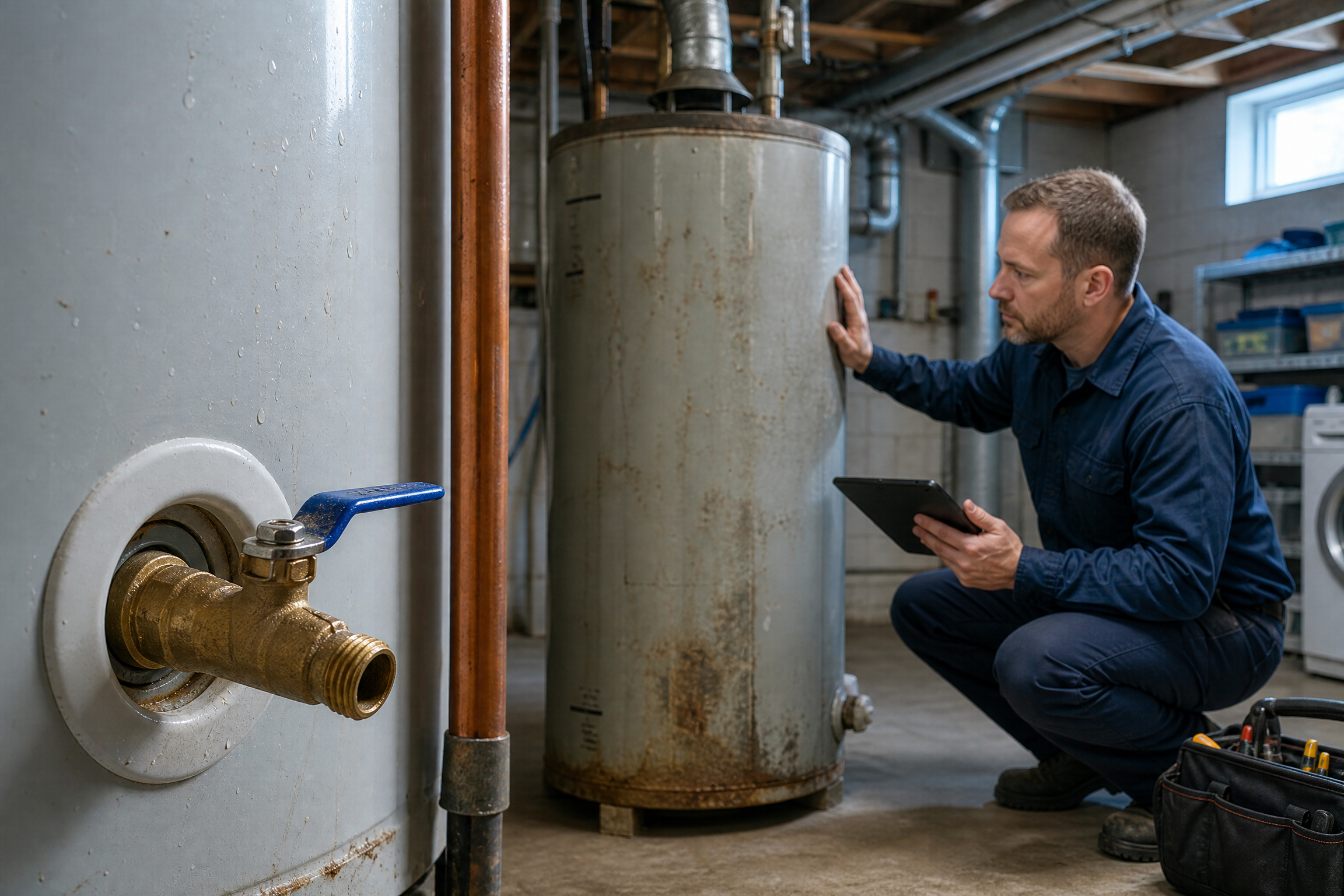
Water collecting underneath a water heater can come from several places. A drain valve, heating-element seal, temperature-and-pressure relief system, plumbing connection or the tank itself can all leave water around the base.
The first useful step is finding where fresh water appears.
A leaking drain valve or fitting may be repairable. Water emerging directly through the tank shell or bottom seam usually means the inner tank has failed and replacement is required.
Faulty drain valves, loose connections, condensation, relief-valve problems and internal tank corrosion are among common water-heater leak sources.
If the leak is active, shut down the heater safely before spending time diagnosing it.
What Should You Do If Your Water Heater Is Leaking From the Bottom?
Start by reducing the chance of water damage and removing energy from the appliance.
For an electric water heater, switch off the dedicated breaker.
For a gas water heater, turn off the gas supply only when the valve is safely accessible and you are confident operating it.
Then close the cold-water supply valve feeding the heater.
A.O. Smith gives the same basic sequence for a leaking unit: shut off electricity or gas, shut off the incoming water supply, then identify the leak source.
Do not reach across standing water to access electrical equipment.
If you smell natural gas, leave the area and treat that as a gas emergency rather than continuing to troubleshoot the water leak.
Once the unit is safely isolated, dry the outside of the tank and the surrounding floor. Watch for the first place new moisture appears.
Saving Plumbing provides 24/7 water heater repair and installation across Toronto and the GTA. Call (416) 271-6745 / 647 932 7176 when you need prompt help.

Image: Tracing the first wet point is more useful than judging the size of the puddle.
Where Is the Water Actually Coming From?
A puddle at the bottom does not prove that the bottom of the tank is leaking.
Water can run down the tank jacket from a connection much higher up before reaching the floor.
| Where fresh water appears | Likely source |
|---|---|
| Drain valve near bottom of tank | Loose, worn or damaged drain valve |
| Lower electric access panel | Heating-element gasket or tank-area leak |
| Bottom seam or tank shell | Internal tank corrosion or tank failure |
| T&P discharge pipe | Pressure, temperature or relief-valve issue |
| Cold or hot connection above tank | Supply connection or fitting |
| Thin moisture film that disappears | Condensation |
| Water plus visible corrosion at base | Possible tank deterioration |
Leak diagnostics specifically include puddles caused by pinhole tank leaks, fitting leaks, T&P discharge and condensation.
Why Is My Water Heater Leaking From the Drain Valve?
The drain valve sits near the bottom of a conventional storage water heater, so even a small leak there can quickly look like a leaking tank.
The valve is used for draining and flushing the heater.
A leak can develop when the valve is not completely closed, its internal seal has deteriorated, the valve body has cracked or the connection has been disturbed during previous service.
A.O. Smith identifies a faulty drain valve as a common water-heater leak source and recommends replacement when the valve no longer seals correctly.
Dry the valve completely and watch the outlet and the point where it enters the heater.
If the water starts there while the surrounding tank remains dry, the valve deserves investigation before the entire heater is condemned.
Avoid forcing a brittle or badly corroded valve. A small seep can turn into a much larger leak if the valve body breaks.
What Does It Mean if the Water Heater Is Leaking From the Bottom Seam?
Water emerging directly through the tank body or bottom seam is more serious than a leaking external valve.
Storage water heaters contain an inner steel pressure vessel surrounded by insulation and an exterior jacket.
Once corrosion creates an opening in that inner tank, the pressure vessel itself is leaking.
severe leaks from a corroded tank generally require water-heater replacement.
An exterior sealant, tape or patch does not restore the integrity of a leaking pressure vessel.
Before deciding the seam is definitely the source, make sure water is not travelling downward from the drain valve, T&P discharge pipe or a connection above.
Drying the heater and tracing the highest fresh wet point is much more reliable than judging where the puddle forms.
Why Is My Water Heater Leaking From the Bottom Left Side?
“Bottom left” is useful as a description, though water-heater layouts vary by manufacturer and model.
On some electric water heaters, the lower portion of the tank contains a heating element behind an access panel.
If water appears around that lower access area, an element gasket may be leaking.
Rheem’s technical leak guidance specifically identifies water or rust around an electric heating element as a potential leak source.
A failed heating-element gaskets are a leak source on electric water heaters.
Do not remove an electric access panel while the unit is energized or while water is present around electrical components.
Turn the breaker off first and arrange an inspection if the leak appears to originate behind the panel.
Why Is My Water Heater Leaking From the Bottom Panel?
On an electric heater, moisture appearing from a lower access panel can point toward the lower heating element, its gasket, or water travelling internally from another part of the tank.
The insulation behind the panel can also hold water, which makes the visible exit point misleading.
A leaking element gasket can sometimes be repaired by replacing the gasket or element when the tank itself remains sound.
Water coming from inside the jacket because the inner tank has corroded is a different situation.
That is why the panel should not simply be opened and the element replaced without confirming where the water originated.
Is a Water Heater Leaking From the Bottom Dangerous?
A leaking water heater should be treated as an urgent plumbing problem.
The immediate risks depend on what is leaking and what surrounds the heater.
Hot water can create a scald hazard. Water near electrical wiring can create an electrical hazard. An uncontrolled tank leak can damage flooring, drywall and stored belongings.
The T&P relief system deserves particular attention because it exists to protect the tank from excessive temperature and pressure.
T&P discharge opening should never be capped or blocked.
A small drain-valve seep and a rupturing tank are very different problems, which is why the leak source matters.
Why Is the T&P Valve Leaking and Making Water Appear at the Bottom?
The temperature-and-pressure relief valve may be installed higher on the tank, but its discharge pipe normally directs water downward.
That can create a puddle near the base that looks like a bottom leak.
A dripping T&P valve can be associated with:
- excessive water pressure
- thermal expansion
- excessive temperature
- a worn relief valve
- a sealing problem
high pressure and thermal expansion are common reasons for T&P valve discharge.
Do not cap the discharge pipe to stop the leak.
The valve is a safety device and the cause of the discharge needs to be diagnosed.
Why Is My Water Heater Leaking From the Bottom and Making Noise?
A leak and unusual noise can occur at the same time without sharing one single cause.
Popping or rumbling during a heating cycle often points toward sediment inside a storage tank. A.O. Smith explains that sediment can trap steam bubbles and create popping sounds as the tank heats.
A leaking water heater also deserves inspection for corrosion, failed valves and tank condition.
If the heater is both leaking and making new or worsening noises, do not assume that flushing alone will solve the problem.
Identify the leak first.
A tank with a failing shell should not be treated like an otherwise healthy heater that only needs sediment maintenance.
How Long Will a Hot Water Heater Last Once It Starts Leaking From the Bottom?
There is no reliable countdown.
A drain-valve leak may remain small until the component is repaired.
A leaking heating-element gasket may be repairable.
An internally corroded tank can worsen unpredictably because the pressure vessel itself has deteriorated.
For that reason, “how many days will it last?” is not a useful way to manage a tank-body leak.
Once water is confirmed to be coming through the tank shell or bottom seam, plan for replacement rather than continued operation.
How Do I Turn Off a Water Heater That Is Leaking From the Bottom?
The correct shutdown depends on the type of heater.
Electric Water Heater
Turn off the dedicated water-heater breaker at the electrical panel.
Then close the cold-water supply valve leading into the heater.
Do not remove an access panel or touch wiring while the unit remains energized.
Gas Water Heater
If the area is dry and there is no gas odour, follow the manufacturer’s shutdown controls for the specific heater.
closing the gas shut-off valve when the homeowner is confident doing so safely.
Then close the cold-water supply.
If you smell gas, leave the property instead of attempting appliance shutdown procedures.
Do You Need to Drain the Tank?
An actively leaking tank may eventually need to be drained, but that process involves potentially scalding water and a large volume of discharge.
You do not need to start draining the heater simply to identify a small leak.
sediment can also obstruct a drain valve during tank draining.
For a serious leak or an unfamiliar installation, isolation and professional draining can be safer.
Can a Water Heater Leaking From the Bottom Be Repaired?
It depends on the component.
A leak from the drain valve, heating-element gasket, plumbing connection or replaceable relief valve may be repairable when the rest of the heater remains in acceptable condition.
A leak through the inner tank or bottom seam generally means replacement.
| Finding | Repair may be possible | Replacement becomes more likely |
|---|---|---|
| Drain valve | Yes | If accompanied by major tank corrosion |
| Heating-element gasket | Yes | If water is also leaking through tank body |
| Supply connection | Often | If tank connection itself is badly corroded |
| T&P valve | Often, after pressure/temperature diagnosis | If heater has broader tank failure |
| Condensation | No repair may be needed | If moisture proves to be an active leak |
| Bottom seam/tank shell | Generally no permanent repair | Yes |
The age of the heater can influence the financial decision, though age alone should not determine the diagnosis.
A relatively newer heater with a serviceable valve problem is very different from an older unit with corrosion through the tank body.
What About a Gas Water Heater Leaking From the Bottom?
Gas water heaters can develop the same drain-valve, tank and plumbing-connection leaks as other storage heaters.
They also have burner and combustion components near the bottom of the appliance.
Water reaching the burner area or gas controls deserves prompt attention.
gas water heaters can produce temporary condensation, especially when cold water enters the tank or the burner fires after a period of inactivity.
Condensation should diminish once operating conditions stabilize.
A recurring puddle that returns independently of those conditions needs a leak investigation.
When Should a Scarborough Homeowner Call for Water Heater Service?
Arrange service promptly when the source cannot be confirmed, water keeps returning, the drain valve will not stop leaking, the lower electric panel is wet, the T&P valve is discharging, or the tank shell appears to be leaking.
Saving Plumbing provides expert Water Heater Repair in Scarborough specifically covering leaks, pressure-valve problems, heating elements and water-heater failures.
Saving Plumbing serves homeowners, landlords, property managers, and businesses in Toronto, Scarborough, North York, Etobicoke, Mississauga, Vaughan, Markham, Pickering, Oshawa, Richmond Hill, Whitby, and surrounding GTA communities. Its listed services include water heater repair installation, tankless water heater service, leak detection, emergency plumbing, and related pipe and drain work.
For 24/7 help with a leaking hot-water tank, contact Saving Plumbing online or call (416) 271-6745 for service in Toronto and across the GTA.
Water Heater Leaking From Bottom FAQs
Why Is My Water Heater Leaking From the Bottom but the Top Is Dry?
The drain valve, lower electric element or tank itself may be the source.
Water can also travel inside the heater jacket before appearing lower down, so a dry top does not guarantee that the leak started at the base.
Dry the unit and watch where moisture first reappears.
Can I Keep Using a Water Heater That Is Leaking?
Continued operation is not recommended until the source has been identified.
A.O. Smith advises shutting off the energy and water supply when a heater is leaking.
A small external valve leak may ultimately be repairable, though you still need to know what is leaking before returning the heater to normal service.
Does a Leak From the Bottom Mean I Need a New Water Heater?
Not automatically.
A drain valve, heating-element gasket or fitting can create a repairable leak near the bottom.
Water emerging through the tank shell or bottom seam usually means the inner tank has failed.
Can a Water Heater Suddenly Burst After It Starts Leaking?
A small puddle does not tell you exactly how quickly a failure will progress.
Tank-body corrosion means the pressure vessel has already lost material, so the leak should be addressed promptly rather than monitored indefinitely.
T&P valve discharge also deserves diagnosis because that valve protects against excessive temperature and pressure.
Should I Put a Pan Under a Leaking Water Heater?
A drain pan can help manage incidental water and can be useful as part of a properly designed installation.
It does not repair a leaking tank.
An actively failing heater still needs to be isolated, diagnosed and repaired or replaced.
