
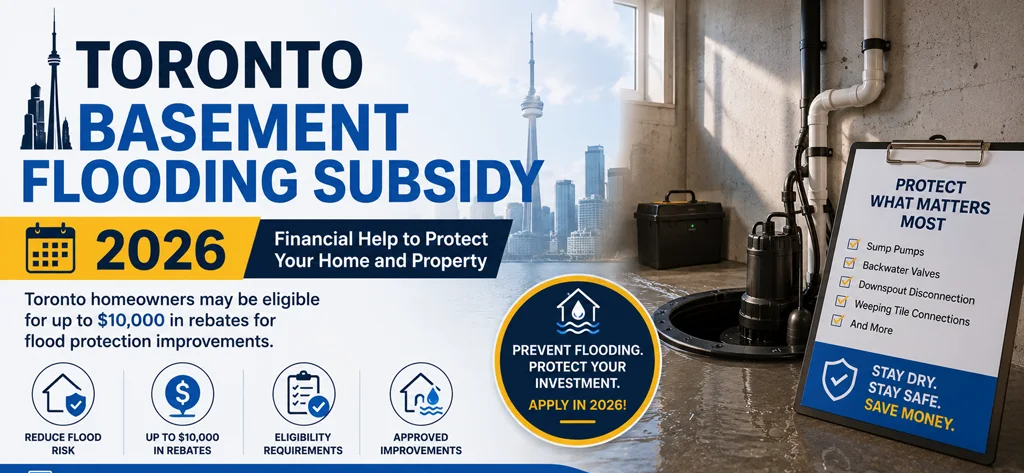
As heavy rainfall events and severe storm surges become increasingly frequent across the Greater Toronto Area (GTA), residential basement flooding has emerged as one of the most significant property risks for homeowners [8]. Municipal stormwater systems, particularly in established Toronto neighborhoods with combined sewer infrastructure, can experience rapid surcharging during sudden cloudbursts . When municipal mains fill to capacity, sewage and stormwater can reverse direction and back up through residential lateral lines, resulting in catastrophic basement flooding, structural damage, and severe health hazards.
To combat this rising vulnerability, the City of Toronto offers the Basement Flooding Protection Subsidy Program, which was substantially expanded to provide up to $6,650 in financial rebates for eligible flood-prevention installations [City of Toronto]. At the core of this municipal protection framework is the backwater valve—a critical mechanical safeguard designed to prevent municipal sewage from infiltrating your home.
TL;DR:
- What is a backwater valve?
- A one-way mechanical valve installed on your main sanitary sewer line that allows wastewater to exit your home while automatically sealing shut to prevent municipal sewage backups during heavy storms.
- How much is the City of Toronto subsidy?
- As of May 2026, the expanded subsidy program covers up to 80% of eligible invoiced costs, up to $1,600 per device (maximum two devices) for backwater valves, and up to $2,250 for sump pumps (plus $300 for battery backup) [City of Toronto]. Total property subsidies can reach up to $6,650 [City of Toronto].
- Who is eligible?
- Owners of single-family, duplex, triplex, or fourplex residential homes within the City of Toronto whose properties are connected to municipal sanitary sewers [City of Toronto].
- Why hire a licensed Toronto plumber?
- City rebates require installations to be performed by a licensed plumbing contractor in strict compliance with the Ontario Building Code and municipal bylaws, complete with proper permits and itemized invoices [City of Toronto].
Understanding the Threat: Why Toronto Homes Need Backwater Valves
The Greater Toronto Area features a diverse mix of modern developments and historical neighborhoods. Many established areas utilize combined sewer systems, where domestic sewage and storm runoff share the same underground conduit. During severe meteorological events, local precipitation rates overwhelm stormwater management capacities, causing hydrodynamic pressure surges in municipal lines.
Without a functioning backflow preventer, this pressurized mixture of stormwater and municipal effluent takes the path of least resistance: up your main sewer lateral and out through your lowest plumbing fixtures, including basement floor drains, shower stalls, and basement toilets.
How a Backwater Valve Operates
A backwater valve is installed directly into your main sanitary drainage pipe beneath the basement floor slab. Inside the transparent inspection housing, a lightweight flap or gate rests on a hinge. Under normal operating conditions, household wastewater flowing outward pushes the gate open, allowing greywater and sewage to discharge freely into the municipal sewer.
When municipal surcharging occurs, incoming backflow exerts reverse pressure against the gate, snapping it tightly shut against a rubber gasket. This mechanical seal isolates your home’s interior drainage network from the municipal main, effectively blocking sewage entry for the duration of the storm surge.
| Operational State | Flow Direction | Valve Mechanism Status | System Function |
|---|---|---|---|
| Normal Drainage | Outbound (House to Municipal Main) | Flap pushed open by outgoing gravity flow | Wastewater exits smoothly without obstruction |
| Surcharge Event | Inbound (Municipal Main to House) | Flap sealed tightly against rubber gasket | Blocks incoming sewage and prevents basement flooding |
| Maintenance Mode | Static / Inspection | Accessible via transparent viewing lid | Allows visual check of seal integrity and debris removal |
The 2026 City of Toronto Basement Flooding Protection Subsidy Breakdown
Navigating municipal financial assistance can significantly offset the capital investment required for comprehensive basement waterproofing. Under the newly expanded program guidelines applicable to work completed on or after November 12, 2025, eligible property owners can claim substantial rebates across multiple flood-mitigation categories [City of Toronto].
Summary of Eligible Subsidy Categories
- Home Plumbing Assessment: Up to 80% of invoiced cost, to a maximum of $500 for a professional, one-time internal plumbing evaluation [City of Toronto].
- Backwater Valve Installation: Up to 80% of invoiced cost, to a maximum of $1,600 per device (covering up to two devices and associated alarms) [City of Toronto].
- Sump Pump & Alarm Installation: Up to 80% of invoiced cost, to a maximum of $2,250 (covering one primary device and alarm) [City of Toronto].
- Battery Backup System: Up to 80% of invoiced cost, to a maximum of $300 for dedicated auxiliary power during municipal grid outages [City of Toronto].
- Storm Sewer Disconnection & Capping: Subsidies available for severing and capping external weeping tile or storm sewer connections [City of Toronto].
Professional Installation vs. DIY: Meeting Municipal Compliance Standards
While hardware stores sell various plumbing components, municipal rebate programs and the Ontario Building Code mandate professional execution. Attempting unpermitted DIY installations on main sanitary lines introduces significant liability and disqualifies property owners from receiving city subsidies.
[Homeowner Inquiry] ---> [Licensed Plumbing Inspection & Quote] ---> [Municipal Permit Acquisition]
                                                                              │
[City Subsidy Disbursement] <--- [Inspection & Itemized Invoice Submission] <--- [Professional Backwater Valve Installation]
Key Requirements for Successful Rebate Approval
- Licensed Contractor Execution: All work must be completed by a fully licensed plumbing contractor holding valid municipal credentials and liability insurance
- Permit Acquisition: A valid plumbing permit must be pulled through the City of Toronto building division prior to commencing subsurface excavation and valve installation
- Itemized Invoicing: Invoices must clearly itemize labour, materials, taxes, and specific device models (such as backwater valves, alarms, and sump pump battery backups)
- Mandatory Inspections: Municipal building inspectors must sign off on the rough-in plumbing work before concrete is poured back over the excavation site.
Frequently Asked Questions (FAQs)
1. How do I know if my Toronto home already has a backwater valve installed?
Many newer homes constructed in the GTA after 2006 include backwater valves as a standard requirement under updated building codes. To check, locate your main cleanout access point in the lowest level of your basement, typically near the front foundation wall where the main sewer line exits the house. Look for a circular plastic access lid flush with the concrete floor. Opening this transparent cover allows you to inspect the internal flap mechanism. If you cannot locate an access port, a licensed plumber can perform a camera inspection or home plumbing assessment to determine your drainage configuration.
2. What is the maximum financial rebate I can receive from the City of Toronto?
As of May 2026, the expanded Basement Flooding Protection Subsidy Program provides a cumulative lifetime maximum of up to $6,650 per eligible residential property [City of Toronto]. This includes up to $1,600 per device for up to two backwater valves ($3,200 total), up to $2,250 for a sump pump, $300 for a battery backup, $500 for an initial home plumbing assessment, and additional allocations for storm sewer disconnection [City of Toronto].
3. How often do backwater valves require maintenance and cleaning?
Backwater valves require routine inspection and maintenance to ensure debris, grease, hair, and sanitary wipes do not obstruct the moving flap. Homeowners should inspect the clear viewing window of their backwater valve at least twice a year—ideally in the spring before heavy seasonal rains and in the late autumn. Furthermore, scheduling an annual professional drain cleaning and maintenance service with a licensed plumber ensures that your entire lateral line remains free of scale and root intrusion.
4. Can a backwater valve be installed in any GTA home?
In the vast majority of single-family, duplex, triplex, and fourplex homes across Toronto, Peel, York, and Durham regions, backwater valves can be successfully retrofitted. However, installation requires breaking through the concrete basement floor slab to access the main sanitary lateral pipe exiting the dwelling. A professional plumbing assessment is necessary to evaluate pipe depth, existing slope, and proximity to municipal connections to ensure proper hydraulic flow and structural compatibility.
5. What happens if a heavy storm occurs while my backwater valve is closed?
When a backwater valve seals shut to prevent municipal sewage backup, your home’s drainage is temporarily isolated from the city main. During this time, any water or wastewater discharged inside your house (such as running taps, flushing toilets, or operating a washing machine) cannot exit the property until the municipal surcharge subsides and the valve reopens. Therefore, during severe storm events, homeowners should minimize indoor water consumption to prevent localized interior overflow while the valve is engaged.
Secure Your Home Today with Saving Plumbing
Protecting your GTA property from the unpredictable weather and surcharging municipal sewers requires expert guidance, precision engineering, and certified installation. At Saving Plumbing, our team of licensed master plumbers provides around-the-clock emergency plumbing service, professional backwater valve installations, and comprehensive assistance with municipal subsidy documentation
Don’t wait for the next major storm to test your basement’s defenses. Contact Saving Plumbing today at (416) 271-6745 or visit our contact page to schedule your professional plumbing assessment and secure your home against costly water damage!
