


A toilet that moves when you sit down or leaves water around its base often has a problem with the seal or fittings connecting it to the floor. The wax ring underneath the toilet may have failed, the mounting bolts could be loose, or the toilet flange may be damaged.
Sometimes the first warning is a small puddle after flushing. Other times, the toilet begins rocking long before any water becomes visible.
If your toilet is rocking and leaking at the base, avoid using it until the problem has been inspected. Continued movement can damage the seal further, allowing wastewater to escape beneath the fixture and potentially affect the bathroom flooring.
Saving Plumbing recently repaired this exact problem in a Scarborough basement bathroom. The job offers a useful example of how a seemingly minor movement can turn into a plumbing leak.
A Loose Basement Toilet in Scarborough That Needed a New Wax Ring
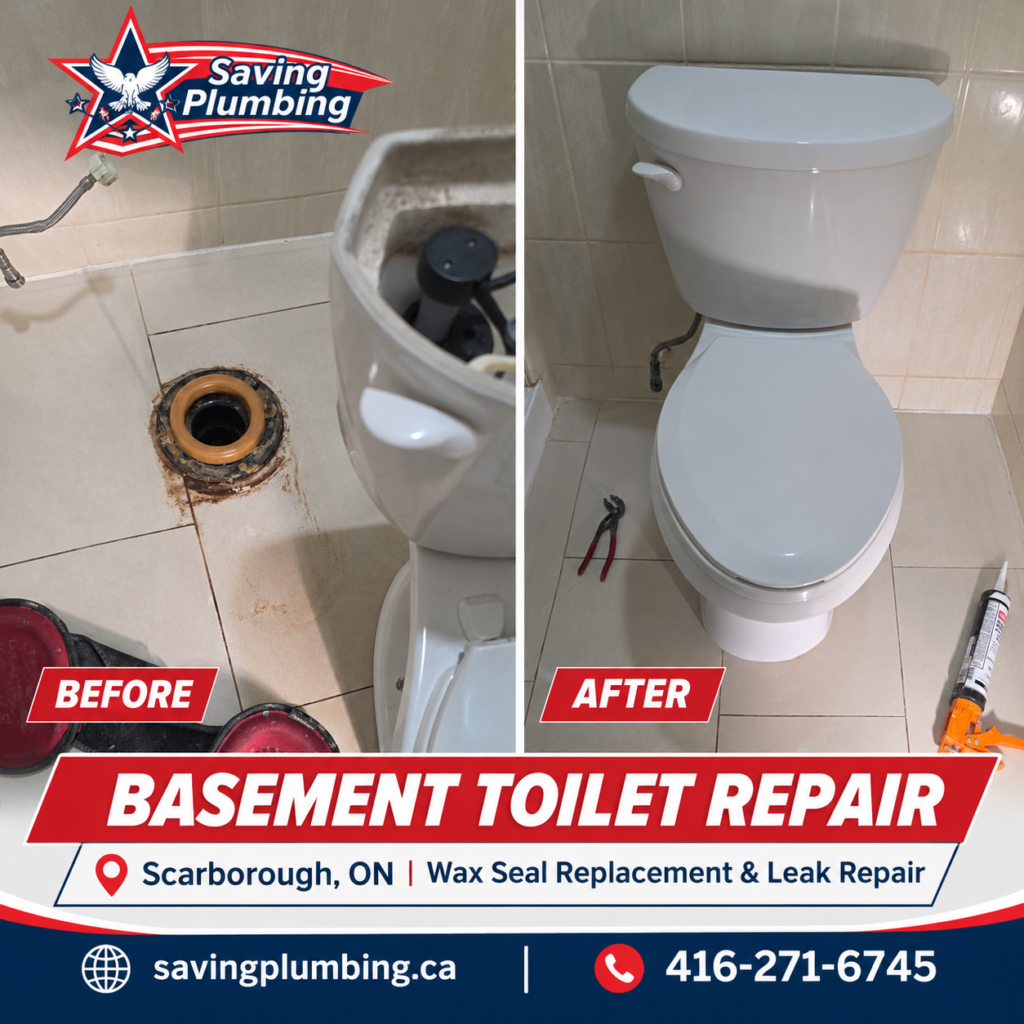
On November 15, 2026, Saving Plumbing completed a residential toilet repair at a home in Scarborough, Ontario.
The homeowner had a basement toilet that was no longer sitting firmly on the floor. It rocked when used, and water was leaking around the base.
Rather than simply tightening the toilet bolts or applying sealant around the floor, the plumber removed the toilet to investigate the connection underneath.
After lifting the toilet, the existing wax seal was found to need replacement.
The team removed the old seal, installed a new wax ring and carefully secured the toilet back in position. Once everything was reconnected, the toilet was tested to confirm that it was stable, flushing properly and no longer leaking.
The repair resolved the reported symptoms without requiring replacement of the entire toilet.
What makes this job worth discussing is that a loose toilet and a leaking toilet are often two parts of the same problem. Movement can damage the seal beneath the bowl, while an unstable mounting connection may allow the problem to return if it isn’t properly addressed.
Below is the original photographs from the November 15 Scarborough basement toilet repair
Also See
Toilet Keep Running? Causes, Fixes & Next Steps
Toilet Flange Repair: Signs, Causes & Solutions [Guide]
What Causes Water to Leak From the Base of a Toilet?
Water around the bottom of a toilet doesn’t always mean the toilet itself is cracked or needs replacing.
The source could be a failed seal beneath the bowl, damaged mounting hardware, a loose water connection or moisture travelling down from somewhere higher on the fixture.
The following problems are worth investigating.
1. The wax ring underneath the toilet has failed
Most conventional floor-mounted toilets use a wax ring to create a seal between the toilet outlet and the floor flange connected to the drainage pipe.
The ring is compressed when the toilet is installed. This helps prevent wastewater and sewer gases from escaping at the connection.
Unlike a rubber gasket, conventional wax doesn’t spring back into its original shape after being compressed.
If the toilet rocks repeatedly, the seal can become disturbed. A gap may develop, allowing water to escape during flushing.
Once the wax seal has been compromised, simply pressing the toilet back into position may not restore a reliable seal.
A plumber generally needs to lift the toilet, remove the old wax and install a suitable replacement after checking the flange and surrounding floor.
2. Loose toilet bolts are allowing the bowl to move
The bolts visible near the bottom of the toilet help secure the bowl to the flange beneath it.
If the mounting hardware becomes loose, damaged or corroded, the toilet may shift slightly whenever someone sits down.
At first, the movement might barely be noticeable. Over time, repeated rocking can affect the wax seal and place additional stress on the floor connection.
It’s tempting to grab a wrench and tighten the bolts until the toilet stops moving.
However, that isn’t always the right solution.
If the wax seal has already failed, tightening the bolts won’t necessarily repair it. Excessive tightening can also crack the porcelain or damage the mounting hardware.
A toilet should sit securely on a stable base without needing excessive bolt pressure to hold it in place.
3. The toilet flange is cracked, loose or incorrectly positioned
The toilet flange, sometimes called a closet flange, is the fitting that connects the toilet to the drainage system and provides an attachment point for the mounting bolts.
Depending on the plumbing installation, a flange may be made from plastic, brass, cast iron or other approved materials.
A cracked flange, damaged bolt slot or deteriorated fastening point can prevent the toilet from being secured properly.
Even a new wax ring may fail prematurely if the flange doesn’t provide a stable connection.
Flange height matters too.
When bathroom flooring is replaced, particularly when new tile is installed over an existing floor, the finished floor height can change relative to the flange.
If the flange sits too low, a standard seal may not make sufficient contact. If the flange is positioned incorrectly or isn’t supported properly, the toilet may also become unstable.
These are installation issues that should be corrected rather than concealed with additional caulking.
4. Water is leaking from the tank or supply connection
Sometimes the water collecting near the toilet base has nothing to do with the wax ring.
A leaking supply line, shut-off valve, tank bolt gasket or tank-to-bowl connection can allow clean water to run down the back or sides of the toilet.
By the time it reaches the floor, the leak may appear to be coming from underneath the bowl.
Condensation on the outside of a cold toilet tank can create a similar impression, particularly in humid conditions.
Before removing the toilet, it’s worth checking whether moisture is appearing higher up on the fixture.
Finding the actual starting point helps avoid unnecessary repairs.
Why Does a Toilet Leak Only When You Flush?
A toilet that leaks only during flushing often points towards a problem with the waste connection beneath the bowl, although a leaking tank-to-bowl gasket can produce a similar symptom.
Here’s why.
When the toilet isn’t being used, there generally isn’t a continuous flow of wastewater through the outlet at its base.
Flushing sends water and waste through the bowl’s internal trap and into the drainpipe below.
If the wax ring isn’t sealing properly, some of that water may escape through the gap between the toilet outlet and the floor flange.
This can explain why the bathroom floor appears dry for hours, only for a small puddle to appear after someone flushes.
But not every failed wax ring produces an obvious puddle.
Depending on the gap and the surrounding floor structure, water may travel beneath the flooring rather than spreading across the visible surface.
In a basement bathroom, this may leave moisture around the toilet or beneath adjacent flooring. In an upstairs bathroom, an undetected leak can also affect the ceiling or building materials below.
A dry floor between flushes does not prove that the toilet’s connection is sound.
If water repeatedly appears after flushing, stop using the fixture and have the source identified.
Why Does Your Toilet Rock When You Sit Down?
A properly installed floor-mounted toilet should remain stable when someone sits on it.
If the bowl shifts from side to side or rocks forward and backward, something is preventing it from sitting securely.
Possible causes include:
- Loose, corroded or incorrectly installed mounting bolts
- A broken or deteriorated toilet flange
- Uneven floor tiles or an irregular floor surface
- An incorrectly positioned flange
- Damaged or weakened subflooring
- An installation that didn’t properly support the toilet base
A rocking toilet doesn’t automatically mean the wax ring is already leaking. However, the movement increases the likelihood that the seal will be disturbed.
This is especially important when a homeowner notices both movement and an occasional sewer smell, dampness around the floor or water appearing after flushing.
Can you fix a rocking toilet by tightening the bolts?
Sometimes loose mounting hardware contributes to the movement, but tightening the bolts is not a universal fix.
If the toilet is rocking because the flange is broken, the floor is uneven or the subfloor has become damaged, additional tightening may make matters worse.
Even when the movement stops, an existing wax seal may remain compromised.
The proper repair depends on identifying why the toilet became loose in the first place.
For minor unevenness, suitable toilet shims may help stabilize the fixture during correct installation. A damaged flange or weakened floor requires a different repair.
The goal isn’t simply to stop the toilet from wobbling. It’s to establish a secure mounting connection and maintain a reliable seal between the toilet and the drainage system.
When Does a Damaged Toilet Flange Need Repair or Replacement?
A damaged toilet flange should be repaired when it can no longer hold the toilet securely or provide the correct connection for a watertight seal.
The flange sits beneath the toilet, where the fixture connects to the drainage pipe. It also holds the mounting bolts that keep the bowl in place.
Because most of the flange is hidden, homeowners often don’t know there’s a problem until the toilet starts moving or leaking.
A plumber may discover:
- Cracked or broken bolt slots: The mounting bolts cannot hold the toilet securely.
- Corroded metal components: Rust has weakened the flange or its attachment points.
- Loose flange fasteners: The flange is no longer firmly attached to the supporting floor.
- Incorrect flange height: The flange sits too low or too high relative to the finished floor.
- Damaged flooring around the drain: The flange may lack adequate support, even when the fitting itself appears intact.
Not every damaged flange needs complete replacement.
Depending on its material, condition and connection to the drainpipe, a plumber may be able to install an approved repair ring or another suitable repair component.
However, if the flange is severely damaged, improperly installed or connected to deteriorating drainage piping, replacing the fitting may be necessary.
The important point is that a new wax ring cannot compensate for a toilet that isn’t mounted securely.
What Happens During a Professional Toilet Wax Ring Replacement?
Replacing a toilet wax ring involves more than lifting the toilet and installing a new seal.
The plumber needs to check the condition of the connection underneath, correct any mounting problems and confirm that the toilet is stable after reinstallation.
For a typical floor-mounted toilet, the process involves several steps.
Removing the toilet and old wax seal
The water supply is shut off, the toilet is drained as much as possible, and the supply connection is disconnected.
The plumber removes the mounting nuts and carefully lifts the toilet from the flange.
Once the toilet is removed, the old wax is cleaned away so the flange and surrounding floor can be inspected.
Checking the flange and flooring
Before installing a replacement seal, the plumber checks whether the flange is cracked, loose, corroded or positioned incorrectly.
The floor around the toilet also needs attention.
Soft wood, damaged flooring or movement around the flange can indicate that the toilet doesn’t have the stable support it needs.
If these problems are present, they should be addressed before the fixture is reinstalled.
Installing a new seal and securing the toilet
After confirming the connection is suitable, the plumber installs an appropriately sized wax ring or compatible sealing product.
The toilet is then carefully positioned over the flange and lowered into place.
Proper alignment is important. Once conventional wax has been compressed, moving or lifting the toilet again can compromise the seal and require another replacement.
The mounting hardware is tightened carefully, without placing excessive pressure on the porcelain. Where necessary, suitable shims are used to stabilize the toilet.
Testing for movement and leaks
After reconnecting the water supply, the plumber refills and flushes the toilet while checking the connections.
The final inspection should confirm that:
- The toilet sits firmly without rocking.
- Water isn’t escaping from the supply or tank connections.
- No water appears around the base during repeated flushing.
- The toilet fills and flushes correctly.
During Saving Plumbing’s November 15 basement toilet repair in Scarborough, the worn wax seal was replaced, the toilet was resecured and the completed installation was tested for stability, flushing and leaks.
That final check confirmed the reported problem had been resolved.
Can a Leaking Toilet Damage the Bathroom Floor?
Yes. Water escaping beneath a toilet can damage flooring, subfloor materials and nearby building components, particularly when the leak continues unnoticed.
The amount of damage depends on how long the leak has existed, how frequently the toilet is used and how the floor is constructed.
In bathrooms with vinyl or laminate flooring, moisture may travel beneath the finished surface before obvious damage appears.
Tile is generally more resistant to surface water, but grout joints and openings around the toilet or drain can allow moisture to reach underlying materials.
On wood-framed floors, prolonged leakage can cause swelling, staining and deterioration of the subfloor.
Basement bathrooms may have different floor assemblies, including concrete slabs, but persistent wastewater leakage still requires attention.
What are the warning signs of hidden water damage?
Check for changes around the toilet rather than looking only for standing water.
These may include darkened or discoloured flooring, soft spots, lifting vinyl, loose tiles, persistent dampness or a musty smell.
A toilet that continues to rock after its bolts have been checked may also indicate damaged flooring or an unstable flange connection.
Not every uneven or discoloured floor is caused by a toilet leak. However, combining those symptoms with water around the base makes an inspection more important.
If wastewater has escaped beneath finished flooring, repairing the seal alone may not address contamination or damaged building materials.
Should You Repair a Leaking Toilet or Replace the Entire Toilet?
A toilet that leaks at the base doesn’t automatically need to be replaced.
If the bowl and tank are in good condition, the flushing mechanism works properly and the problem is limited to the wax seal or mounting connection, repairing the installation is often sufficient.
That was the outcome of the November 15 Scarborough job. The toilet was reinstalled with a new wax ring rather than replaced.
However, replacement may make more sense when the porcelain is cracked, the fixture has recurring mechanical problems or the cost of multiple repairs approaches the cost of a suitable new toilet.
| Toilet condition | What may be needed |
|---|---|
| Failed wax ring, otherwise sound toilet | Replace the seal and reinstall correctly |
| Loose toilet with intact flange | Correct the mounting or support problem and assess the seal |
| Cracked or deteriorated flange | Repair or replace the flange as appropriate |
| Soft or damaged flooring | Repair the supporting floor before securing the toilet |
| Cracked porcelain bowl | Generally replace the toilet |
| Repeated fill valve or flapper problems | Evaluate the parts and overall toilet condition |
The decision should be based on the actual condition of the fixture.
For example, a relatively new toilet with a failed wax seal may only need a straightforward repair. An older toilet with cracked porcelain and several other defects may be a better candidate for replacement.
A plumber can assess the condition of the fixture and explain which repairs are necessary before recommending a new toilet.
How Much Does It Cost to Fix a Toilet Leaking at the Base in Scarborough?
The cost depends on whether the repair involves a simple wax ring replacement or additional work beneath the toilet.
A failed seal with an intact flange and stable floor is usually less involved than a repair requiring flange replacement, damaged flooring or drainage pipe modifications.
The main factors affecting the cost include:
- Whether the toilet can be removed and reinstalled without replacing the fixture
- The condition and accessibility of the existing flange
- Whether new mounting bolts, shims or other fittings are required
- Damage to the subfloor or surrounding bathroom finishes
- Labour, service-call charges and the timing of the repair
A plumber may not be able to confirm the full scope until the toilet has been removed and the flange is visible.
For homeowners in Scarborough or elsewhere in Toronto, it’s reasonable to ask whether an estimate covers removing and reinstalling the toilet, replacing the seal, checking the flange and testing the completed repair.
If additional damage is discovered, the plumber should explain the necessary work before proceeding.
How Can You Prevent a Toilet From Becoming Loose Again?
Once a toilet has been properly repaired, it should remain stable during ordinary use.
You don’t need to check the mounting bolts constantly, but it’s worth paying attention to changes in how the toilet feels and operates.
If it begins shifting when someone sits down, investigate the movement before it becomes more noticeable.
Keep an eye on water collecting around the floor, especially after flushing. Check the supply connection and tank for visible moisture so a leak from above isn’t mistaken for a failed floor seal.
During bathroom renovations, make sure the toilet flange is correctly positioned relative to the new finished floor. Adding tile or changing the floor assembly without accounting for flange height can create installation problems.
For basement bathrooms, recurring moisture around the toilet should never be dismissed simply because the surrounding floor is concrete.
A toilet that stays properly supported is less likely to disturb its seal.
Frequently Asked Questions About Loose and Leaking Toilets
Can a toilet wax ring leak without water showing on the floor?
Yes. Water can sometimes escape beneath the toilet and travel into the surrounding floor assembly without forming a visible puddle. Persistent odours, movement or signs of moisture damage may justify inspecting the connection.
Is it safe to keep using a rocking toilet?
It’s better to stop using the toilet until the cause is identified. Continued movement can compromise the seal, loosen mounting hardware or worsen damage to an already weakened flange.
Will caulking around the toilet base stop a wax ring leak?
No. Caulk is not a substitute for the seal between the toilet outlet and the floor flange. Applying caulk over a leaking connection may conceal escaping water without correcting the problem.
How long should a toilet wax ring last?
A properly installed wax ring can remain effective for many years. It doesn’t have a fixed replacement schedule. Premature failure is often associated with movement, improper installation, flange problems or disturbing the toilet after the wax has been compressed.
Can I reuse a wax ring after lifting the toilet?
Conventional wax rings should not be reused after the toilet has been lifted. The wax has already been compressed and may not create a reliable seal when the toilet is reinstalled.
Does a rocking toilet always mean the flange is broken?
No. Loose mounting hardware, uneven flooring and improper installation can also cause movement. The flange should be inspected when the toilet is removed, but its condition cannot be determined from rocking alone.
Why does my toilet smell like sewage but isn’t leaking?
A compromised wax seal can sometimes allow sewer odours to escape without producing an obvious visible leak. Other possible causes include dry traps in nearby fixtures or drainage and venting problems. An inspection is needed to identify the source.
Don’t Ignore a Toilet That Moves or Leaks Around the Base
A loose toilet may continue flushing normally, which makes the problem easy to overlook. But movement, water near the floor and recurring odours are signs that the installation deserves attention.
In the Scarborough basement repair completed on November 15, replacing the worn wax ring and properly securing the toilet resolved the homeowner’s reported problems.
Other homes may require flange repairs, new mounting hardware or attention to damaged flooring. The correct solution depends on what is found beneath the fixture.
Saving Plumbing provides toilet repairs in Scarborough, including leaking toilet bases, wax ring replacement, loose toilet connections and residential bathroom plumbing repairs.
If your toilet rocks when someone sits down or water appears around the base after flushing, contact Saving Plumbing at (416) 271-6745 to arrange an inspection.

