


Kitchen Sink Clogged and Pipes Rusting? When Drain Cleaning Isn’t Enough
A clogged kitchen sink is frustrating enough. Finding rusty, deteriorating pipes underneath makes the situation more complicated.
If your kitchen sink drains slowly and the metal pipes inside the cabinet are showing rust, corrosion or signs of leakage, you may be dealing with two separate plumbing problems. One is restricting wastewater flow. The other involves the condition of the drainage components themselves.
Drain snaking can clear many kitchen sink blockages, but it cannot repair a corroded P-trap or restore metal that has already deteriorated. In some cases, the blockage needs to be cleared and the damaged piping replaced.
That’s exactly what Saving Plumbing encountered during a recent residential kitchen sink repair in Scarborough, Ontario.
Also See – Is your kitchen sink gurgling?
A Scarborough Kitchen Sink Repair That Needed More Than Drain Snaking
Saving Plumbing recently attended a home in Scarborough after the homeowner experienced a clogged kitchen sink and problems with the drainage assembly beneath it.
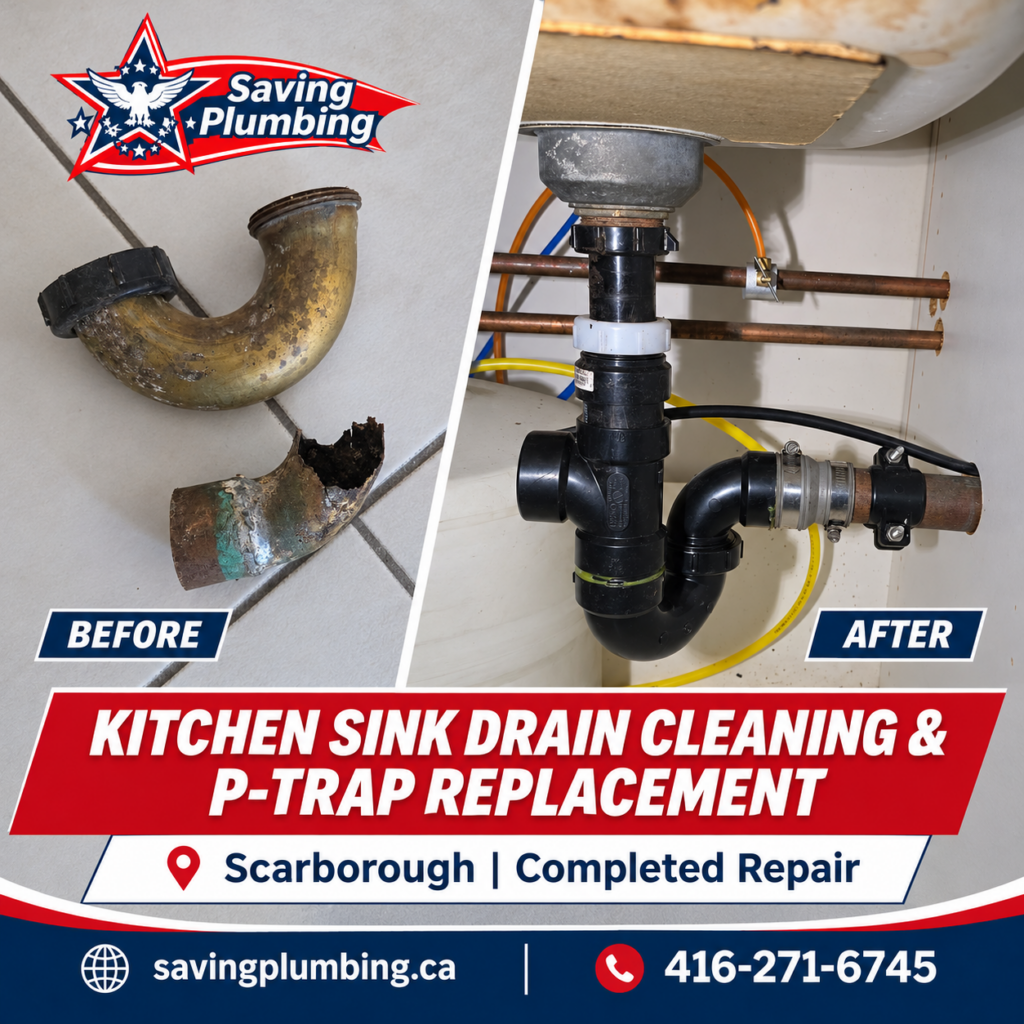
The kitchen sink wasn’t draining properly, and the existing metal P-trap had become badly rusted and damaged.
After inspecting the plumbing, the team determined that clearing the obstruction alone wouldn’t be enough.
The repair involved two separate tasks.
First, the plumber used a drain snake to clear the blockage and restore water flow through the kitchen drain.
The damaged metal P-trap assembly was then replaced with a new drain connection. Once everything was fitted, the plumbing was tested to confirm that wastewater could drain properly without leaking beneath the cabinet.
The repair addressed both the immediate clog and the deteriorated plumbing component.
This distinction matters because homeowners often assume that once water begins flowing again, the entire drainage problem has been solved.
Sometimes it has. But when the pipes themselves are severely corroded, removing a blockage doesn’t reverse the damage.
Below is Saving Plumbing’s original photographs from the Scarborough kitchen sink repair here,
Why Do Kitchen Sink Drainpipes Become Rusty or Corroded?
Metal kitchen sink drainpipes can deteriorate over time because of moisture, material ageing and exposure to substances passing through the drainage system.
Not all drainpipes corrode in the same way. The pipe material, installation conditions and surrounding environment influence how deterioration develops.
Older metal drain assemblies
Some homes have metal P-traps, tailpieces or drain connections that have been in service for many years.
Depending on the material, these components may develop corrosion at threaded connections, joints or along the pipe wall.
Once corrosion becomes advanced, the remaining metal may be too weak to support a reliable repair.
A fitting that looks solid from the outside can sometimes be badly deteriorated beneath deposits or rust.
Moisture inside the sink cabinet
A slow leak around a sink strainer, faucet connection or drain joint can keep the cabinet damp.
Over time, persistent moisture can contribute to corrosion on susceptible metal fittings.
This is why staining, swollen cabinet panels and a musty smell shouldn’t be ignored, even when there isn’t an obvious puddle.
Corrosion inside the drainpipe

Wastewater carries food particles, cleaning products, dissolved substances and other materials through the kitchen drain.
Internal corrosion can develop in susceptible metal piping depending on its material, age and exposure conditions.
As a pipe deteriorates, its internal surface may become rough or develop deposits that interfere with drainage.
However, a rusty P-trap doesn’t automatically mean rust caused the blockage. Grease, food debris or another obstruction may be responsible.
The actual condition of the pipe must be assessed before deciding whether cleaning or replacement is appropriate.
What Does a P-Trap Do Under Your Kitchen Sink?
The P-trap is the curved section of drainpipe beneath a sink. Its shape allows a small amount of water to remain inside the bend after the sink has finished draining.
That standing water creates a seal that helps prevent sewer gases from travelling from the drainage system into the kitchen.
The trap also connects the sink’s drain assembly to the downstream drainage piping.
In a typical kitchen sink setup, several components work together:
- The sink strainer collects wastewater from the basin.
- The tailpiece carries water down from the sink outlet.
- The P-trap holds the water seal and directs wastewater towards the drain.
- The trap arm connects the trap to the drainage piping inside the wall.
- The slip-joint connections or other approved fittings secure the assembly, depending on the installation.
A problem with any one of these components can affect how the sink drains or allow water to escape into the cabinet.
Can a rusty P-trap cause a kitchen sink clog?
Yes, deterioration and deposits inside a metal trap can contribute to restricted drainage. However, most kitchen sink blockages involve material accumulating inside the drain.
Cooking grease, food scraps and other debris can build up over time, particularly where the flow is already restricted.
The City of Toronto advises residents not to pour cooking fats, oils or grease down kitchen drains because these materials can harden and accumulate inside pipes.
A deteriorating P-trap may make an existing drainage issue more difficult to resolve, but it is important to distinguish between the blockage and the damaged pipe.
In the Scarborough repair, the plumber addressed both conditions rather than assuming one repair would solve everything.
How Can You Tell Whether a Kitchen Sink Needs Drain Cleaning or Pipe Replacement?
A slow-draining sink doesn’t necessarily need new pipes. Similarly, a pipe showing advanced corrosion may require replacement even when wastewater still flows.
The symptoms can help you understand what needs investigating.
| What you notice | Possible explanation | What may be needed |
|---|---|---|
| Water drains slowly without visible pipe damage | Grease, food debris or another localized blockage | Drain cleaning or snaking |
| Water backs up into the sink | Partial or complete drainage obstruction | Locate and clear the blockage |
| Rust or corrosion around metal trap connections | Deteriorating metal fittings | Inspect and possibly replace the affected components |
| Water dripping beneath the sink | Loose connection, damaged washer or deteriorated pipe | Identify the leak and repair or replace the component |
| Repeated clogs after previous cleaning | Remaining buildup, pipe defects or a downstream restriction | Further drain inspection |
| Cracked or perforated metal P-trap | Loss of pipe integrity | Replace the damaged assembly |
These are possible explanations rather than a substitute for inspecting the plumbing.
For example, a clogged kitchen drain may be cleared without replacing anything. But if the trap is badly corroded, trying to reuse it could leave the homeowner with a leak after the blockage is removed.
A proper assessment considers both the flow of water and the physical condition of the drain assembly.
Can Drain Snaking Damage Old or Rusted Pipes?
Drain snaking is an established method for clearing many kitchen sink blockages. A plumber feeds a flexible cable into the drain to reach and break through or remove an obstruction.
When the drainage piping is in suitable condition, this can restore water flow without replacing the pipe.
However, the condition of older or corroded pipes matters.
Severely weakened metal may already have thin sections, damaged joints or deteriorated fittings. Mechanical cleaning can expose an existing weakness or place stress on compromised components.
This doesn’t mean every older metal drain should be replaced before snaking. It means the plumber needs to consider the pipe’s condition and select the appropriate access point and equipment.
In some cases, removing the P-trap allows better access to a blockage farther along the drain.
If the trap is heavily corroded, the plumber may find that its connections cannot be safely separated and reused.
That is one reason inspecting the visible piping before attempting to clear a stubborn blockage is worthwhile.
Why not just use chemical drain cleaner?
Chemical drain cleaners may seem like an easier option when the sink stops draining.
The problem is that they don’t establish why the blockage occurred, and they cannot repair metal that has rusted through.
Some products contain caustic or corrosive ingredients that can create hazards when they remain trapped in a blocked drain.
If a plumber later needs to disconnect the P-trap or use mechanical cleaning equipment, residual chemicals can create additional risks.
For a kitchen sink with visibly damaged piping, identifying and repairing the actual problem is a better approach than repeatedly pouring chemicals into the drain.
How Do Plumbers Replace a Rusted Kitchen Sink P-Trap?
When a kitchen sink P-trap is severely corroded, replacing the damaged section is usually more reliable than trying to patch it.
The first step is to inspect the existing drain assembly. A plumber needs to establish whether the corrosion is limited to the P-trap or extends into the tailpiece, trap arm or drainage connection inside the wall.
This matters because replacing one fitting won’t solve the problem if adjacent piping is also deteriorating.
For a typical replacement, the plumber will:
- Disconnect the damaged drain assembly. The old P-trap is removed carefully, particularly if corrosion has weakened the joints or surrounding metal.
- Inspect the remaining connections. The sink tailpiece, trap arm and wall connection are checked for damage, corrosion or signs of previous leakage.
- Install the replacement trap. A suitable P-trap assembly is fitted using compatible materials and approved connections.
- Check the alignment. The trap must connect properly without unnecessary strain on the joints or an incorrect drainage arrangement.
- Test the installation. Water is run through the sink while the plumber checks drainage performance and looks for leaks.
During Saving Plumbing’s recent Scarborough repair, the team cleared the kitchen drain blockage and replaced the deteriorated metal P-trap assembly. The completed plumbing was then tested to confirm proper drainage without leaks.
That final step is especially important beneath kitchen cabinets, where a small leak can go unnoticed until the cabinet floor begins to swell or develop stains.
What Type of Pipe Is Best for Replacing a Rusted P-Trap?
The appropriate replacement depends on the existing plumbing, the installation requirements and the materials approved for the application.
Many residential kitchen sink drain assemblies use plastic drainage components, while some installations have metal traps or tailpieces.
ABS plastic P-traps
ABS, or acrylonitrile butadiene styrene, is commonly used for drainage, waste and vent piping in Ontario.
It doesn’t rust like ferrous metal piping and is suitable for many residential drainage applications when installed with the correct fittings and approved connections.
However, not every existing metal drain assembly can be replaced with ABS using the same configuration. The plumber needs to account for the trap connection, pipe sizing and installation requirements.
PVC drainage components
PVC is another material used in certain drainage applications.
The type of PVC, fitting design and applicable product standards matter. A component intended for one plumbing application should not automatically be substituted for another.
Metal drain assemblies
Metal P-traps are still used in some installations. Suitable metal components can provide dependable drainage when properly selected and installed.
Their long-term condition depends on the material, exposure and maintenance.
The objective isn’t simply to replace metal with plastic. It’s to install a durable, compatible drain assembly that maintains the trap seal and connects correctly to the existing drainage system.
If the plumber discovers that the downstream piping is also corroded, replacing only the visible P-trap may not be enough.
What If the Kitchen Sink Is Still Clogged After Replacing the P-Trap?
If water continues to drain slowly after the P-trap has been cleaned or replaced, the obstruction may be farther along the drainage system.
The trap is only one section of the kitchen sink drain.
Wastewater travels from the sink through the trap arm, into the branch drain and eventually towards the building’s main drainage system.
A restriction anywhere along that route can affect the sink.
Grease and food buildup inside the branch drain
Kitchen wastewater frequently carries small amounts of cooking grease, oils, food residue and detergent.
Over time, these materials can accumulate inside drainpipes, especially where flow is restricted.
The City of Toronto advises homeowners to keep fats, oils and grease out of household drains because they can contribute to sewer blockages.
If buildup is farther inside the wall, replacing the P-trap alone won’t remove it.
Deteriorated piping inside the wall
Older metal drainage piping may also deteriorate in concealed areas.
Depending on the material and condition, corrosion or internal deposits can reduce the effective opening inside a pipe.
A plumber may need to investigate beyond the visible under-sink assembly when recurring blockages suggest a larger problem.
A shared drain blockage
In some kitchens, a dishwasher or second sink basin connects to the same drainage system.
If wastewater backs up into another fixture or both sink basins drain poorly, the restriction may be located downstream of their shared connection.
A dishwasher discharging water into a blocked sink drain can sometimes cause wastewater to rise into the sink basin.
Observing when and where the backup occurs helps narrow down the likely location.
When is a drain camera inspection necessary?
A camera inspection may be appropriate when a blockage keeps returning, the condition of concealed piping is uncertain, or ordinary drain cleaning hasn’t identified the cause.
It isn’t necessary for every kitchen sink clog.
For many localized blockages, a plumber can diagnose and clear the problem using conventional tools.
When recurring symptoms suggest a damaged pipe, a deeper restriction or another defect, further inspection may help avoid repeated temporary repairs.
How Much Does It Cost to Replace a Kitchen Sink P-Trap in Scarborough?
The cost of replacing a kitchen sink P-trap depends on the condition of the existing assembly, the materials required and whether the job involves additional drain cleaning.
A straightforward replacement involving an accessible P-trap is generally less involved than a repair requiring modifications to the tailpiece, wall connection or concealed drainpipe.
The main cost factors include:
- Condition of the old trap: Severely corroded fittings may be difficult to remove without disturbing adjacent connections.
- Extent of the replacement: The plumber may need to replace the tailpiece, trap arm or additional fittings.
- Drain blockage: Clearing a clog farther inside the branch drain requires additional work.
- Existing plumbing materials: Connecting different approved materials may require compatible transition fittings.
- Access: Tight cabinets, built-in fixtures or difficult wall connections can increase labour.
- Service timing: Emergency or after-hours plumbing work may have different service charges.
An accurate estimate should distinguish between drain cleaning and replacing damaged components.
For example, a homeowner may request drain snaking because the sink is blocked. If the plumber finds a badly deteriorated P-trap, replacing the trap becomes a separate part of the repair.
Ask what the quoted work includes, which components will be replaced and whether testing is included.
A reliable repair should address the actual condition of the drainage system rather than simply getting the water moving again.
How Can You Prevent Kitchen Sink Clogs and Drainpipe Problems?
Most kitchen sink maintenance comes down to keeping unnecessary waste out of the drain and noticing small leaks before they cause damage.
You don’t need special equipment to adopt a few useful habits.
Keep cooking grease out of the sink. Allow fats, oils and grease to cool and dispose of them appropriately rather than pouring them down the drain. Hot water and detergent do not guarantee that grease will travel safely through the entire drainage system.
Use the sink strainer. Catching food scraps before they enter the drain helps reduce the amount of material accumulating inside the trap and branch piping.
Check beneath the sink occasionally. Look for moisture around drain connections, corrosion on metal fittings and staining on the cabinet floor.
Pay attention to changes in drainage. If water begins draining more slowly than usual, investigate before the sink becomes completely blocked.
Avoid repeatedly using harsh chemical drain cleaners. They won’t repair deteriorating pipes or correct a damaged joint.
If a kitchen sink has required several drain cleanings within a short period, it may be worth investigating why the blockage keeps returning.
Persistent drainage problems can indicate a restriction or defect beyond the visible P-trap.
Frequently Asked Questions About Rusted Kitchen Sink Pipes
Should I replace a rusty pipe under my kitchen sink?
Surface discolouration doesn’t always mean a pipe has failed. However, heavy corrosion, flaking metal, damp joints or visible deterioration can indicate that replacement is necessary. A plumber can assess whether the pipe is still sound or has lost its structural integrity.
Can a rusted P-trap cause a leak?
Yes. Corrosion can weaken metal piping and its connections. If the material deteriorates enough, small holes or damaged joints may allow wastewater to escape when the sink drains.
Will a drain snake remove rust from the inside of a pipe?
A drain snake is primarily intended to clear obstructions. It may disturb some deposits, but it does not restore corroded metal or repair damaged pipe walls. Severely deteriorated piping may require replacement.
Why does my kitchen sink keep clogging after drain cleaning?
The blockage may not have been fully removed, or buildup may be recurring farther along the drain. Grease accumulation, damaged piping and restrictions inside a shared branch drain are possible causes. Repeated clogs deserve further investigation.
Can I replace a metal P-trap with a plastic one?
Often, yes, provided the replacement components are approved for the installation and are compatible with the existing drainage system. Pipe sizing, connections, trap configuration and applicable plumbing requirements must be considered.
Is a leaking P-trap an emergency?
A small leak may not require emergency service, but it should be addressed promptly. Stop using the sink if wastewater is escaping beneath the cabinet. Active leaks, significant water damage or wastewater backing up into the home may require more urgent attention.
Does a rusty kitchen sink pipe mean the entire drain needs replacing?
Not necessarily. Corrosion may be limited to one fitting or section of pipe. The surrounding components should be inspected before deciding whether a localized repair or more extensive replacement is necessary.
When Your Kitchen Sink Needs More Than a Simple Drain Cleaning
A clogged kitchen sink doesn’t always have one cause.
Sometimes food debris or grease buildup is the only problem, and drain cleaning is enough to restore normal flow. In other cases, the visible plumbing is also deteriorating and needs attention.
The recent Scarborough repair completed by Saving Plumbing illustrates that difference. The kitchen drain required snaking to remove the obstruction, while the corroded metal P-trap needed replacement.
Addressing both problems restored drainage and left the homeowner with a properly connected, leak-free sink drain assembly.
If your kitchen sink drains slowly, repeatedly backs up or has rusted plumbing beneath the cabinet, Saving Plumbing provides drain cleaning in Scarborough along with kitchen sink drain repairs and P-trap replacements.
For an inspection or plumbing services in Scarborough and surrounding GTA communities, contact Saving Plumbing at (416) 271-6745.
Sources
