
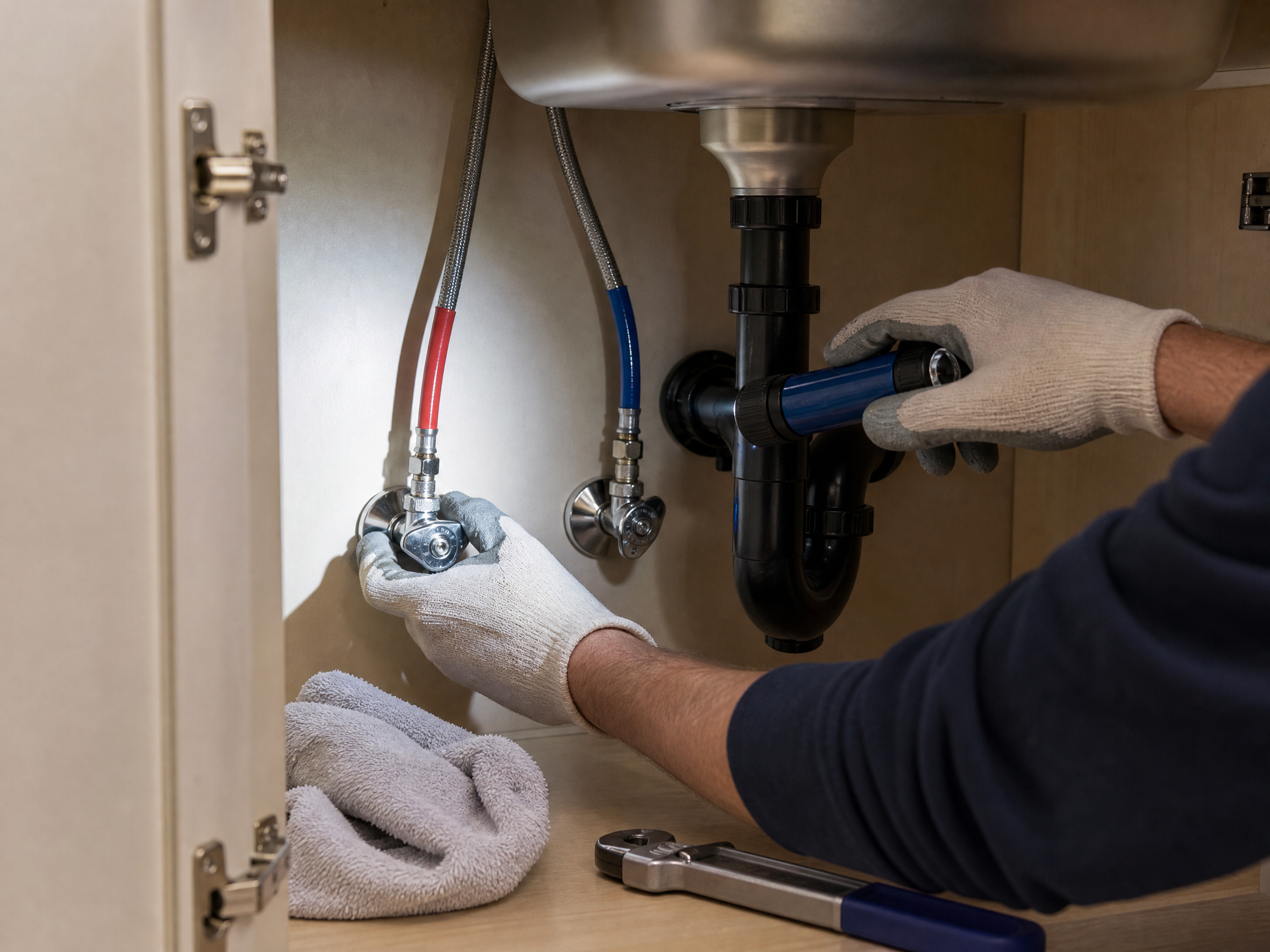
Water leaking under your kitchen or bathroom sink in Scarborough? Learn how to identify supply-line, shut-off valve, faucet hose and drain leaks.
How to Find Where the Water Is Coming From
Water underneath a sink can come from the faucet supply lines, shut-off valves, pull-down hose, faucet connections, sink drain or P-trap.
The fastest way to narrow it down is to watch when the water appears.
A leak that continues while the faucet is completely off deserves attention on the pressurized supply side. Water that appears only while the faucet is running can come from the faucet, hose or one of its connections. A cabinet that stays dry until the sink drains points toward the drain assembly.
For Scarborough homeowners, identifying that pattern before parts are removed can make the repair much more straightforward. Saving Plumbing provides faucet repair services throughout Scarborough and surrounding Toronto and GTA communities.
What Does the Timing of an Under-Sink Leak Tell You?
Different parts under the sink carry water at different times.
| When water appears | Where to investigate first |
|---|---|
| Faucet off, water still appearing | Supply line, shut-off valve or pressurized connection |
| Only while faucet is running | Faucet connection, internal faucet leak or hose |
| Only while pull-down sprayer is used | Pull-down hose, wand connection or quick-connect fitting |
| Only when sink drains | Drain flange, tailpiece, P-trap or drain connection |
| Water appears around faucet mounting hole | Faucet base, gasket or water travelling through the deck opening |
| Leak begins after shut-off valve is touched | Valve stem, compression joint or deteriorated shut-off valve |
| Water is spraying continuously | Pressurized supply failure requiring immediate isolation |
This timing test is more useful than starting with the wettest spot in the cabinet.
Water can travel along a hose, fitting or pipe before falling, so the puddle may form several inches away from the actual leak.

Why Is Water Leaking Under the Sink When the Faucet Is Off?
Water that appears when nobody is using the sink usually directs attention toward plumbing that remains pressurized.
The hot and cold supply lines connecting the shut-off valves to the faucet contain water whenever those valves are open. A loose connection, damaged hose or leaking valve can therefore release water while the faucet handle remains off.
Start by drying both supply lines and the shut-off valves completely.
Watch the connection where each hose meets the valve and where it connects to the faucet above. Run a dry paper towel around the fittings. A small wet mark often exposes a slow leak before a drop becomes visible.
A flexible line showing swelling, fraying, corrosion or moisture along the hose itself deserves replacement rather than an improvised patch.
A leak from the shut-off valve needs separate attention. Water may appear around the valve stem, handle, outlet connection or the point where the valve connects to the home’s supply pipe.
If an older valve is difficult to turn, forcing it can make the situation worse.
Why Does It Leak Under the Sink Only When I Turn the Faucet On?
This pattern narrows the investigation.
If everything remains dry while the faucet is off and water appears once the tap begins running, inspect the parts that carry water during faucet operation.
That can include the connection between the supply line and faucet, an internal hose, the faucet body, or a pull-down assembly.
Some faucet failures occur above the countertop and send water downward through the mounting opening. This can make the leak appear to originate underneath the sink even though the failed seal is higher inside the fixture.
Moen documents this behaviour on kitchen faucets. Depending on the model, damaged O-rings, internal seals, pull-out components or connections can allow water to travel through the faucet assembly. Moen recommends identifying the exact faucet model before selecting replacement components because its repair kits differ between models.
If the water is clearly entering around the faucet base itself, use our separate kitchen faucet leaking at the base guide for that diagnosis. That issue deserves its own repair path.
Why Does My Pull-Down Kitchen Faucet Leak Under the Sink?
Pull-down and pull-out faucets have an additional hose moving through the cabinet below the sink.
That creates several possible leak points.
Water may escape where the spray wand connects to the hose, along a damaged flexible hose, or at the quick-connect fitting where the hose attaches to the faucet.
Move the spray head through its normal range while someone watches underneath the sink.
A hose leak often becomes much easier to see while the sprayer is actively being used.
Manufacturer-specific connections matter here.
Delta’s support documentation explains that a quick-connect fitting must be fully seated and should produce a secure click. Delta also identifies the O-ring inside some quick-connect systems as a possible leak point.
Moen likewise advises checking the connection between the pull-out or pull-down hose and spray wand, including the sealing washer or O-ring used by that particular faucet model.
This is why a generic “universal” repair part can create more trouble. Identify the faucet manufacturer and model before ordering the hose or connector.
Why Does My Sink Leak Underneath Only When Water Drains?
A leak that begins when water leaves the basin usually points toward the drain system.
The faucet supply lines may be working normally.
Possible leak locations include the sink strainer or drain flange, the vertical tailpiece, slip-joint connections and the P-trap.
You can separate a drain leak from a faucet leak with a simple controlled test.
Dry everything beneath the sink first. Put water into the basin while keeping it from draining immediately. Watch underneath.
Then release the water.
If the cabinet remains dry until the basin empties, inspect the drain assembly.
A drain leak may become more visible when a larger volume of water moves through the pipe. Filling part of the basin and then releasing it can expose a weak joint that does not leak during a small trickle from the faucet.
The P-trap connections deserve inspection as well. Misaligned piping or a worn washer can allow water through a slip joint.
This issue belongs with sink and drain repair rather than faucet cartridge repair.
How Can You Find a Small Leak Under the Sink?
Begin with a completely dry cabinet.
Remove stored items and wipe every visible plumbing component. Water already sitting on hoses and fittings makes a slow leak difficult to trace.
Check the supply side first with the sink empty.
Leave the faucet off and observe the shut-off valves and supply connections. Then turn the faucet on briefly and watch the upper connections.
Use the sprayer separately if the faucet has one.
Finally, let a larger amount of water drain from the basin while watching the drain flange, tailpiece and P-trap.
A dry paper towel is useful around fittings because a very small leak leaves an obvious mark.
Once you find the first place where fresh water appears, stop recreating the leak unnecessarily.
What If the Shut-Off Valve Starts Leaking When You Turn It?
An under-sink shut-off valve can remain untouched for years.
Operating an older valve can sometimes expose deterioration around the stem or connections.
If the valve begins dripping when you turn the handle, dry it and identify where the water is coming from. Avoid repeatedly tightening or forcing a seized valve.
A valve that cannot reliably isolate the fixture creates another problem during faucet repair because the water cannot be safely shut off at that location.
In that situation, the home’s main water supply may need to be isolated before the valve itself is repaired or replaced.
This is especially useful information to give the plumber when booking the appointment. Saying “the faucet is leaking” and saying “the cold shut-off valve leaks whenever I try to close it” describe very different service calls.
Can You Repair a Leaking Supply Connection Yourself?
Some accessible connections can be serviced after the water has been safely shut off and the leak source has been confirmed.
Connection type matters.
Faucet plumbing can use threaded fittings, compression connections, sealing washers, O-rings and proprietary quick-connect systems. Adding plumber’s tape to every fitting is not a universal solution because many connections seal through a gasket or compression surface.
Kohler’s installation guidance, for example, directs installers to connect the faucet supply correctly and inspect all connections for leakage after water is restored.
Manufacturer instructions should guide any work on the faucet itself.
Stop DIY troubleshooting when a shut-off valve will not close, the fitting is heavily corroded, a hose is split, water is spraying, or you cannot identify the connection with confidence.
When Should a Leaking Faucet Be Repaired Instead of Replaced?
The condition of the faucet matters more than the presence of one leak.
A good-quality faucet with a serviceable hose, O-ring, cartridge or connection may be worth repairing.
Replacement becomes more practical when the faucet body is damaged, several components are failing, corrosion is substantial, or the manufacturer no longer provides compatible repair parts.
Brand identification can influence this decision.
Moen directs customers to identify the exact faucet model before selecting O-rings and repair kits. Delta also maintains model-specific quick-connect and hose components.
That part availability can turn what appears to be a complete faucet failure into a much smaller repair.
If the leak is specifically around the faucet base, avoid duplicating that discussion here. Our separate faucet-base guide covers seals, O-rings, mounting hardware and cartridge-related causes in more detail.
What Should Scarborough Condo Owners Do About an Under-Sink Leak?
A small leak inside a condo cabinet can become a building issue quickly if water begins travelling into flooring, walls or another unit.
Stop the water source if you can safely isolate it and document where the leak appears.
If water is spreading outside the unit or the failed plumbing may involve building infrastructure, contact the property manager or condo corporation promptly.
Responsibility for repairs in an Ontario condominium depends on the corporation’s declaration, standard-unit definition and other governing documents. The Condominium Authority of Ontario specifically advises owners to review those documents when determining responsibility for plumbing and other components.
The source of the leak still matters.
A faucet hose inside the unit and a pipe classified as part of the common elements can create different repair and insurance questions.
When Is Water Under the Sink a Plumbing Emergency?
Active pressurized water changes the urgency.
A supply hose that has split can release water continuously because it is connected directly to the home’s water supply.
Shut off the fixture valve if it works safely. Use the main water shut-off when the local valve cannot control the leak and you know how to operate it.
Arrange urgent plumbing service when water is spraying, the shut-off valve cannot stop the flow, the cabinet is filling quickly, water is moving into flooring or another level of the home, or electrical components are becoming wet.
Saving Plumbing’s Scarborough plumbing service page includes leaking pipes and faucet repairs among the plumbing problems handled locally, with its Scarborough location at Milner Business Court .
Service is available in communities including Agincourt, Malvern, Birch Cliff, Cliffside and surrounding Scarborough neighbourhoods, with additional coverage throughout Toronto and the GTA.
For faucet and sink problems, you can also visit our faucet and sink repair and installation services in Scarborough
Call (416) 271-6745 or request a free quote.
Frequently Asked Questions
Why Is There Water Under My Sink but Everything Looks Dry?
Water may be travelling along a hose or pipe before falling into the cabinet.
Dry every component, then watch for the first new moisture rather than looking only at the puddle.
A leak that occurs intermittently may also depend on faucet use, sprayer use or sink drainage.
Why Does My Faucet Leak Underneath but Never Drip From the Spout?
The spout and the plumbing underneath the sink have different sealing points.
A supply hose, quick-connect fitting, pull-down hose or internal faucet connection can leak below the countertop while the spout itself remains completely dry.
The timing of the leak helps determine which part should be inspected.
Why Is My Kitchen Faucet Hose Wet Under the Sink?
Operate the pull-down or pull-out sprayer and watch the hose.
Water travelling down from the spray head connection can make the entire hose look wet. A damaged hose or quick-connect fitting can also leak directly underneath the sink.
Manufacturer-specific replacement parts are usually required.
Can a P-Trap Leak Look Like a Faucet Leak?
Yes.
Both leaks can leave water in the same cabinet.
If the plumbing remains dry while the faucet runs into a plugged basin and begins leaking when that water is released, the drain assembly deserves attention first.
