


Before spending thousands of dollars on a new interlocking driveway, it’s worth finding out what’s buried underneath it.
Your home’s main water service pipe or underground sewer lateral may run beneath the driveway, front lawn or landscaped areas before connecting to municipal infrastructure. If one of those pipes develops a serious problem after the new paving is installed, accessing it could mean disturbing part of the finished driveway.
You don’t necessarily need to replace underground plumbing just because you’re renovating your driveway. However, an inspection makes sense when the home has older piping, recurring sewer backups, unexplained water pressure problems or a history of underground leaks.
A recent project completed by Saving Plumbing in Scarborough illustrates why coordinating plumbing work with driveway construction can be worthwhile.
A Scarborough Underground Pipe Replacement Before New Interlocking Was Installed
Saving Plumbing recently completed an underground main line replacement at a residential property in Scarborough, Ontario.
The homeowner was preparing to install a new interlocking driveway. Rather than finish the paving first and risk having to excavate the area later, the underground plumbing work was scheduled ahead of the landscaping.
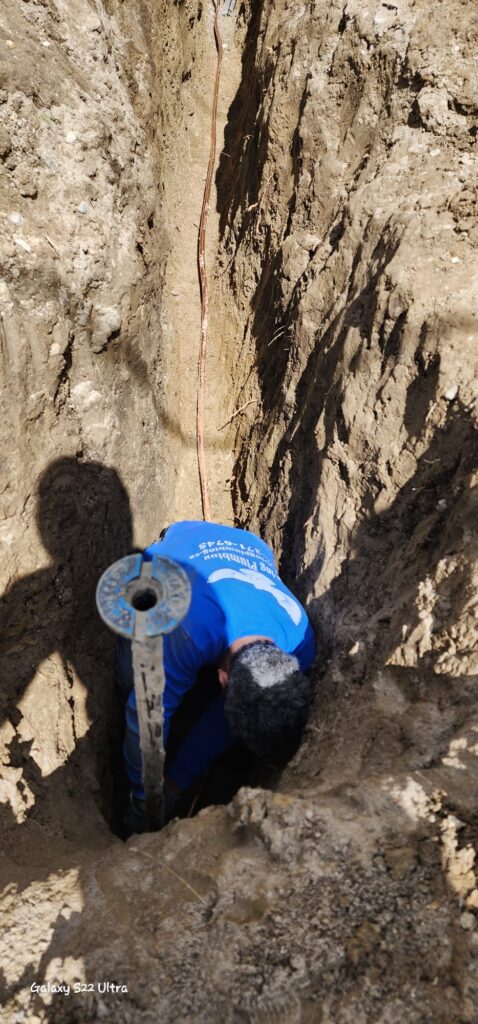
The project required excavation from the house’s foundation towards the municipal property line.
Once the trench was prepared, the crew installed crushed gravel bedding to support the new pipe. The original job notes specify ¾-inch crushed gravel.
The work also involved positioning the line at the required depth, preparing the installation for inspection and testing, and coordinating backfilling and compaction before the driveway contractor laid the new interlocking stones.
The practical advantage was straightforward: the necessary underground work could be completed while the driveway area was already being prepared for construction.
That doesn’t mean every driveway renovation needs a new water or sewer line. The condition of the existing piping should determine whether replacement is worthwhile.
But when underground plumbing work is already required, completing it before installing new pavers can reduce the need to disturb finished landscaping.
Below see the original underground excavation photographs in Scarborough Ontario – For more Check out Saving Plumbing’s Scarborough sewer line replacement service


What Underground Plumbing Pipes Might Run Beneath Your Driveway?
Most homeowners rarely think about the underground plumbing between their house and the street.
Unlike a leaking kitchen faucet or clogged bathroom sink, problems with buried pipes aren’t always visible until they affect water pressure, drainage or the surrounding ground.
Two important systems to understand are the water service line and the sewer lateral.
Main water service line
The water service line carries drinking water from the municipal distribution system into the home.
Depending on the property, the private-side pipe may run beneath the front lawn, driveway or another part of the lot.
Problems with this pipe can result in leaks, reduced water flow or a loss of water supply.
In older homes, the pipe material and size may also differ from those used in newer installations.
The City of Toronto distinguishes between municipal and private water service infrastructure. Homeowners are generally responsible for the private portion of the water service on their property.
Underground sewer lateral
The sewer lateral carries wastewater from toilets, sinks, showers and other plumbing fixtures towards the municipal sanitary sewer.
For some properties, that pipe passes through the front yard or beneath a driveway before reaching the street connection.
Unlike the pressurized drinking-water service, a conventional sanitary sewer lateral typically relies on gravity to carry wastewater away from the house.
If the pipe becomes blocked, cracked, displaced or otherwise damaged, homeowners may experience recurring drain backups, sewage odours or other drainage problems.
The City of Toronto identifies private-side sewer service lines as the responsibility of the property owner.
How do you know where these pipes are located?
The location varies by property.
A neighbouring house may have a similar layout, but that doesn’t guarantee its buried services follow the same route.
Municipal service records, accessible plumbing cleanouts and professional inspections may help establish the location of existing piping.
In Toronto, homeowners can also request available sewer or water service records from the City.
Before any excavation, required underground utility locates must be obtained. Locates do not necessarily identify every privately owned line, so additional investigation may be necessary.
When Should You Inspect Underground Pipes Before Installing a New Driveway?
An inspection is most useful when there is a reason to suspect the existing plumbing may need attention.
Age alone doesn’t prove that a buried pipe is defective. Some underground service lines remain functional for decades, while others develop problems because of their material, installation conditions or surrounding soil.
Consider investigating the plumbing before driveway construction if you notice any of the following.
Recurring sewer backups or slow drainage throughout the house
A single slow bathroom sink often has a localized blockage.
However, repeated backups affecting several fixtures may indicate a restriction farther along the drainage system.
Tree roots, accumulated debris, displaced joints and damaged sewer piping are possible causes.
If a sewer problem has already required repeated cleaning, a camera inspection may help determine whether the buried lateral needs repair.
Unexplained water pressure or flow problems
A noticeable reduction in water flow can sometimes be associated with an undersized, restricted or deteriorating water service pipe.
However, pressure and flow problems can also originate inside the home.
Before recommending an underground pipe replacement, a plumber should assess the available water supply, internal piping, valves and other possible causes.
Not every pressure complaint indicates a leaking service line.
Signs of an underground water leak
Unexplained wet ground, persistent soft spots or water collecting in an unusual area may justify further investigation.
These symptoms can have several causes, including drainage problems, groundwater and irrigation leaks.
A buried water service leak is one possibility, particularly when other evidence supports it.
The source needs to be identified before excavation is recommended.
Older plumbing with an unknown history
Homes in established Scarborough neighbourhoods such as Agincourt, Wexford, Bendale and West Hill may have undergone several plumbing or landscaping changes over the years.
Some properties retain sections of their original underground services, while others have had partial replacements.
The important question isn’t simply how old the house is. It’s what material was installed, whether repairs have occurred and what condition the pipe is in today.
A homeowner planning significant driveway work may benefit from checking available service records and investigating known plumbing concerns before construction begins.
Should You Replace an Old Sewer Line Before Laying Interlocking Pavers?
Not automatically.
A sewer lateral that is structurally sound, draining correctly and showing no significant defects may not need replacement simply because new interlocking stones are being installed.
In that situation, preventive replacement could create unnecessary expense.
However, if a sewer camera inspection identifies serious deterioration, repeated root intrusion, collapsed sections or connections that have shifted out of alignment, repair or replacement may be warranted.
The timing becomes important when the defective section lies beneath the proposed driveway.
A repair completed before paving can allow excavation, pipe installation, testing and trench restoration to be coordinated with the broader construction schedule.
If the same problem is discovered after the driveway is finished, some or all of the newly installed surface may need to be lifted for access.
Can sewer camera inspection show whether replacement is necessary?
A sewer camera can help identify visible defects inside a drain or sewer lateral, including cracks, joint displacement, root intrusion and certain types of obstruction.
It can also help determine where a suspected problem is located.
However, a camera inspection has limitations. It may not fully reveal conditions outside the pipe, and the view can be obstructed by wastewater or debris.
A plumber should interpret the findings alongside the property’s drainage history and other available information.
Minor deposits or an isolated blockage don’t always justify replacing an entire sewer lateral.
The purpose of the inspection is to support a repair decision, not automatically recommend excavation.
- City of Toronto: Water and Sewer Service Connections
- City of Toronto: Plumbing and Drain Permit Requirements
- Ontario Dig Authority: Utility Locate Requests

Is Replacing a Water Service Line Different From Replacing a Sewer Lateral?
Yes. Although both pipes may be buried beneath the same driveway, they perform different jobs and require different methods of diagnosis and installation.
A water service line delivers pressurized drinking water to the house. A sewer lateral carries wastewater away from the property, usually by gravity.
This difference affects how a plumber identifies problems, selects replacement materials and tests the completed work.
| Consideration | Water service line | Sewer lateral |
|---|---|---|
| Main purpose | Supplies drinking water | Carries wastewater to the sewer |
| Common concerns | Underground leaks, reduced flow, ageing or undersized piping | Blockages, root intrusion, cracked pipes, displaced joints |
| Typical investigation | Pressure and flow testing, leak detection, service records | Drain cleaning, sewer camera inspection, pipe locating |
| Installation requirements | Approved pressure-rated water piping and connections | Approved drainage piping with correct alignment and slope |
| Testing | Applicable pressure and leakage testing | Applicable drainage and leakage testing or inspection |
If a homeowner has recurring sewer backups, replacing the water supply pipe will not solve the drainage problem.
Likewise, a sewer camera inspection cannot determine the condition of a separate pressurized drinking-water line.
Before driveway construction begins, the plumber should identify which service is affected and whether the concern justifies repair or replacement.
What Happens During Underground Pipe Replacement?
Underground pipe replacement usually involves several stages, from locating buried utilities to restoring the excavated ground.
The exact process depends on the type of pipe, its depth, the location of other infrastructure and whether work extends towards the municipal property line.
1. Locating underground utilities
Before excavation, utility locates are required to identify buried infrastructure that may be affected by the work.
These can include gas lines, electrical cables, telecommunications infrastructure and municipal water or sewer services.
In Ontario, excavation planning involves requesting locates through Ontario Dig Authority, formerly Ontario One Call.
Privately owned pipes and cables may require additional locating arrangements because not every private service is identified through the standard utility locate process.
No excavation should begin until the required locate responses and clearances have been received.
2. Excavating the existing underground line
After the work area has been assessed, excavation can begin.
The trench must provide appropriate access to the existing pipe while protecting nearby utilities, structures and surrounding ground.
Trench safety is particularly important when excavation becomes deep enough to create a risk of soil collapse. Appropriate protective systems and safe excavation procedures are required.
For a driveway renovation, the plumber and excavation contractor should also consider how the work will affect access to the property.
3. Preparing the trench and installing the new pipe
Once the existing pipe has been exposed, the damaged section or service line can be removed or replaced according to the approved scope.
The trench bottom and bedding must be prepared for the selected pipe material and installation conditions.
During Saving Plumbing’s recent Scarborough project, the crew used ¾-inch crushed gravel for bedding while completing an underground main line replacement ahead of the driveway renovation.
Bedding helps support installed piping, but the appropriate material and placement depend on the pipe specifications and approved installation requirements.
A sewer lateral must have the required drainage slope. A water service line has different installation requirements because it carries pressurized drinking water.
Depth, frost protection, bedding and connections all need to suit the actual installation.
4. Inspection and testing before backfilling
One of the most important stages happens before the pipe is buried again.
The required inspections and tests should be completed while the installation remains accessible.
Depending on the work, these may involve inspecting pipe connections, checking drainage alignment, performing pressure or leakage tests, and confirming compliance with permit requirements.
Backfilling too early can create unnecessary work if a connection fails testing or an inspection identifies something that needs correction.
5. Backfilling and preparing for driveway installation
After the applicable inspections and testing are completed, the trench can be backfilled using suitable material and compaction methods.
This step matters when interlocking pavers will be installed above the excavation.
Improperly restored trenches can settle over time, potentially leaving depressions or uneven areas in the finished driveway.
The paving contractor should know where excavation occurred and whether any further preparation is required before installing the driveway base.
Can Underground Pipes Be Replaced Without Digging Up the Entire Driveway?
Sometimes. Trenchless pipe replacement methods can reduce the amount of surface excavation required, but they are not suitable for every property.
Two methods homeowners may encounter are pipe bursting and pipe lining.
Pipe bursting
Pipe bursting involves pulling a replacement pipe through the route of an existing buried pipe while breaking or displacing the old pipe.
Depending on the installation, access pits may be required at one or both ends.
This approach may reduce the need for a continuous open trench.
However, the suitability of pipe bursting depends on the existing pipe, its connections, surrounding utilities, soil conditions and available access.
Sewer pipe lining
Cured-in-place pipe lining is another option for certain existing sewer pipes.
A liner is introduced into the existing pipe and cured to create a new internal lining.
It may be suitable for some forms of deterioration where the pipe still provides an acceptable route for rehabilitation.
However, lining isn’t the answer to every sewer defect.
Severe collapse, major misalignment, insufficient remaining capacity or other structural conditions may make excavation or replacement necessary.
Lining also does not apply to every type of water service installation.
When is open excavation the better option?
Open excavation may be necessary when the existing pipe has collapsed, the route needs to change, connections require reconstruction or trenchless methods are unsuitable.
If the driveway has already been removed as part of a planned renovation, open excavation may also be practical because the work area is accessible.
The right method depends on the pipe’s condition and location, not simply which option involves less digging.
How Much Does Underground Pipe Replacement Cost in Scarborough?
Underground pipe replacement costs vary considerably because no two excavation projects have exactly the same conditions.
A short, accessible pipe repair may require much less work than replacing a buried service line running from a house towards the street.
The main factors include:
- Length of the pipe: Longer replacement runs generally require more materials and labour.
- Excavation depth: Deeper trenches require additional excavation and safety measures.
- Soil and site conditions: Rock, unstable soil, groundwater and restricted access can affect the work.
- Existing utilities: Nearby gas, electrical or telecommunications infrastructure may require special precautions.
- Pipe material and diameter: Water service and sewer piping have different specifications.
- Surface restoration: Removing and reinstating concrete, asphalt, interlocking pavers or landscaping adds work.
- Permit and inspection requirements: The scope and location of the repair determine which approvals may be needed.
The timing of driveway construction can also affect the total project budget.
For example, if a damaged underground line is replaced before new interlocking is installed, excavation and restoration can be coordinated with the planned driveway work.
That may avoid the additional disruption of removing recently installed pavers.
However, replacing a functioning pipe without evidence of a problem is not automatically a cost-saving decision.
The more useful question is whether the condition of the existing line justifies replacement while access is available.
What should an underground plumbing estimate include?
Before approving the work, ask for a clear explanation of the proposed scope.
The estimate should identify which line is being repaired or replaced, the approximate work area, the installation method and the responsibilities for permits, testing, inspections, backfilling and surface restoration.
If the driveway contractor will complete the final paving, confirm where the plumbing contractor’s responsibilities end.
This helps prevent disagreements about excavation, compaction or restoration after the work begins.
Do You Need Permits to Replace Underground Water or Sewer Pipes in Toronto?
Underground water service and drainage work may require plumbing or drain permits, inspections and additional municipal approvals depending on the location and scope.
The City of Toronto provides a stand-alone plumbing and drain permit process for qualifying work that is not part of another building construction project.
Separate requirements may apply when work affects municipal infrastructure, a public road allowance or the driveway entrance.
For example, reconstructing or repaving a driveway can involve street work permit requirements where the project affects the public right-of-way.
The rules are not necessarily identical for work entirely on private property and work extending into City-controlled land.
Before excavation, the homeowner and contractor should confirm which approvals apply.
It’s also important to distinguish a permit from a utility locate. Receiving a permit does not eliminate the need for required locate requests before digging.
Who Is Responsible for Underground Pipes Between the House and the Street?
In Toronto, responsibility generally depends on which portion of the water or sewer service is located on private property and which portion belongs to the municipal system.
Homeowners are typically responsible for maintaining and repairing their private-side water service and sewer lateral.
The City is generally responsible for its municipal infrastructure, subject to the applicable service boundary and specific circumstances.
This distinction becomes particularly important when excavation approaches the property line.
A pipe problem near the street does not automatically mean the City is responsible for the repair.
Before undertaking work near the municipal connection, confirm the service boundary, ownership and required approvals.
How Should You Coordinate Plumbing Work With Your Driveway Contractor?
If you’re planning a new interlocking driveway, bring up underground plumbing before the old surface is removed.
The plumber and driveway contractor do not necessarily need to begin work at the same time, but they should understand each other’s schedule.
A practical sequence is:
- Review the existing plumbing. Identify known sewer problems, underground leaks and any planned water service upgrades.
- Investigate concerns before construction. Arrange a sewer camera inspection, service-line assessment or other appropriate investigation if symptoms justify it.
- Confirm whether underground repairs are needed. Establish the scope before scheduling driveway installation.
- Arrange the necessary permits and utility locates. Do this before excavation begins.
- Complete plumbing excavation and installation. Allow for required testing and inspection before backfilling.
- Prepare the ground for paving. Coordinate trench backfilling, compaction and the driveway base with the paving contractor.
- Install the new driveway surface. Begin the final paving only after the underground work and required ground preparation are complete.
This approach helps avoid situations where a newly finished driveway must be opened to complete plumbing work that could have been addressed earlier.
It also gives the homeowner a clearer understanding of which contractor is responsible for each stage.
Frequently Asked Questions About Underground Plumbing and Driveway Renovations
Should I get a sewer camera inspection before replacing my driveway?
A sewer camera inspection is worth considering if the home has recurring backups, known sewer defects or an older lateral with an uncertain condition. It is not automatically necessary for every driveway renovation.
Can a sewer pipe run underneath a driveway?
Yes. Sewer laterals can pass beneath driveways, lawns and other parts of a property depending on the house layout and municipal connection location.
How deep are underground water and sewer lines in Scarborough?
The depth varies according to the service type, property grading, frost protection requirements, connection elevations and installation conditions. A plumber should confirm the actual depth and applicable requirements rather than relying on a single estimate for every Scarborough property.
Can interlocking pavers be lifted and reinstalled after pipe repairs?
Often, yes. Interlocking pavers can sometimes be removed and reused if they remain in suitable condition. However, the bedding and base may need reconstruction, and colour or settlement differences can affect the finished appearance.
Does low water pressure mean my underground water line needs replacing?
Not necessarily. Low water pressure or reduced flow can result from several issues, including valves, internal piping restrictions, fixtures or municipal supply conditions. Testing is needed to identify the actual cause.
Who arranges underground utility locates in Ontario?
The party responsible for excavation must ensure the appropriate locate process is completed before digging. Ontario Dig Authority coordinates requests involving its member infrastructure owners, while some privately owned buried services require separate locating arrangements.
Is trenchless pipe replacement always cheaper than excavation?
No. Trenchless methods may reduce surface disruption, but equipment, access requirements, pipe conditions and the length of the replacement all affect cost. Open excavation may be more practical in some situations, especially when the driveway is already being reconstructed.
Planning a New Driveway? Check What Is Buried Beneath It First
A driveway renovation is a good opportunity to consider the condition of underground plumbing, particularly when the property has a history of sewer backups, water service leaks or other unresolved issues.
That doesn’t mean every older Scarborough home needs new underground pipes.
The decision should be based on the condition of the service line, the results of appropriate inspections and the cost and disruption of the proposed work.
During Saving Plumbing’s recent Scarborough project, the underground main line replacement was coordinated with the homeowner’s upcoming interlocking driveway installation. Completing the necessary pipe work first allowed the area to be prepared for the paving contractor without having to disturb a newly finished surface.
If you’re renovating a driveway in Scarborough or another Toronto neighbourhood and have concerns about buried water or sewer pipes, Saving Plumbing can assess the plumbing and help determine whether repairs should be completed before paving begins.
For underground plumbing inspections and residential pipe repairs, contact Saving Plumbing at (416) 271-6745.
Sources
- Stand-alone Plumbing and Drain Permits explains the municipal application process and identifies buried water, sanitary and storm piping work. toronto.ca
- Toronto Driveway Construction Permit Requirements explains when street work permits are required for driveway construction or reconstruction. toronto.ca
- Ontario Dig Authority: Utility Locates for Contractors confirms the requirement to request locates before excavation. Ontario Dig Authority
